A refrigerated truck is not a box truck with a cooling unit bolted on. It is a thermal system in which the insulation, the door, the floor, the refrigeration unit and the delivery pattern are sized against each other. A body that holds −18 °C on the test bay can lose the load in the first hour of a delivery round if the unit is undersized for the ambient temperature or the door opens twenty times a shift. Factory prices in 2026 run from roughly USD 16,000 for a 2-tonne gasoline mini reefer van to more than USD 90,000 for an 8x4 frozen box, and much of that spread is insulation and refrigeration capacity rather than chassis. This guide covers the temperature classes and what they require, the body types, insulation specifications, unit options with a sizing method, heat-load calculation, payload limits, cold-chain compliance, price bands, five-year costs, the twelve-point RFQ, export, maintenance and safety.
Every refrigerated order starts with a temperature duty, not a volume. A body built for chilled produce at +4 °C cannot carry frozen food at −18 °C on the same unit, and a body built for −18 °C is heavier, more expensive and needs a larger unit than a chilled box of the same size. State the product temperature, the ambient temperature range, the maximum time the door is open and the tolerance the cargo allows. Four classes cover most cold-chain work:
| Class | Product temperature | Typical cargo | Insulation | Notes |
|---|---|---|---|---|
| Chilled | 0 to +4 °C | Meat, dairy, fresh fish, prepared food | 50–60 mm PU | Door openings dominate the heat load |
| Controlled ambient | +8 to +15 °C | Produce, flowers, chocolate, beverages | 40–50 mm PU | Cheaper body, smaller unit |
| Frozen | −18 °C | Frozen food, ice cream, seafood | 80–100 mm PU | Heated door frame and a defrost cycle are required |
| Deep-frozen and pharma | −20 to −25 °C, or +2 to +8 °C for vaccines | Ice cream in distribution, pharmaceuticals, vaccines | 100 mm PU | Two temperature recorders, calibrated probes, documented excursion procedure |
The tolerance matters as much as the setpoint. Ice cream distribution is usually held at −20 °C with −18 °C permitted for short periods; vaccines need +2 to +8 °C with a logged record for every trip; fresh produce tolerates a band but not a cold snap. A quotation that offers "−18 °C capable" without stating the ambient temperature and the door-opening duty is not a specification.
| Type | Capacity | Working pattern | What to specify |
|---|---|---|---|
| Mini reefer van | 6–10 m³, 1.5–2 t payload | Urban last mile, small shops, pharmacies | Gasoline or electric chassis, box height for standing |
| Insulated box truck | 12–25 m³, 3–10 t payload | Regional distribution, wholesale delivery | Panel thickness, door type, floor drain, side door |
| Frozen box truck | 20–50 m³, 8–20 t payload | Frozen distribution, cold storage line-haul | 80–100 mm panels, heated door frame, unit capacity at −20 °C |
| Multi-temperature body | 25–50 m³, two or three compartments | Mixed chilled and frozen delivery on one route | Movable bulkheads, independent evaporators, separate controls |
| Cold-plate (eutectic) body | 8–20 m³ | Fixed overnight routes, silent operation, no engine running at stops | Plate weight and charge time, charging station, route length per charge |
| Reefer semi-trailer | 70–90 m³ | Long-haul and port-to-warehouse | Unit model, ATP certificate, side-door options |
The choice is driven by the route, not by the payload alone. Cold-plate bodies are quiet and cheap to run on a fixed round that fits their charge, but a route change strands them. Multi-temperature bodies solve mixed deliveries but lose volume to bulkheads and need two evaporators, which changes both the price and the service burden.
The body is the largest part of the thermal system and the easiest place to save money invisibly. Panels are polyurethane (PU) foam bonded between glass-reinforced plastic (GRP) or aluminium skins; the specification that matters is foam density, panel thickness, the k-value the builder claims, and how the joints are sealed. A 60 mm panel with a good seal outperforms a 100 mm panel with thermal bridges at every rib and door edge.
| Duty | Wall and roof | Floor | Door | Practical k-value |
|---|---|---|---|---|
| Chilled 0 to +4 °C | 50–60 mm PU, GRP skin | 60–80 mm with aluminium tread plate | Single rear door, double gasket | 0.45–0.60 W/m²K |
| Frozen −18 °C | 80–100 mm PU, GRP skin | 100 mm with insulated floor and drain | Rear door with heated frame, anti-icing strip | 0.35–0.45 W/m²K |
| Deep-frozen −25 °C | 100 mm PU, sealed joints | 100–120 mm, insulated underfloor | Heated four-point locking door, air curtain option | 0.30–0.40 W/m²K |
Details that decide whether the number is real: foam density of 38–45 kg/m³ (low-density foam loses its k-value as it ages), continuous inner and outer skins with no exposed foam at the door opening, sealed floor-to-wall joints, a floor that can be washed without water reaching the insulation, and a drain that does not freeze. Ask for the panel drawing and the thermal test data, and check the door gasket: a gasket that does not compress evenly leaks more heat than a panel of the wrong thickness.
Four unit families cover road transport, and the right one follows from how the truck is used rather than from the box size.
| Type | How it works | Best for | Watch out for |
|---|---|---|---|
| Direct-drive (engine PTO) | Compressor driven from the chassis engine | Delivery trucks that run most of the day | No cooling with the engine off; unit capacity depends on engine speed |
| Self-powered diesel | Own diesel engine drives the compressor | Long standing periods, trailers, line-haul | Fuel and service of a second engine; emissions rules in city centres |
| Electric standby / hybrid | Diesel on the road, mains power at the depot | Depots with shore power, quiet overnight cooling | Mains capacity at the parking bay; cable and socket discipline |
| Battery-electric | Battery pack drives an electric compressor | Urban low-emission zones, silent night delivery | Charge time and range penalty; battery warranty terms |
Whatever the family, the figure to compare is capacity at the working point: kW of cooling at −20 °C box temperature in a +30 °C ambient, not a headline capacity at 0 °C. Two units of the same nominal size can differ by 30 percent at the frozen working point, which is exactly where the door opens.
The unit must remove four heat flows: transmission through the body, heat from the product and its packaging when it is loaded warm, infiltration through door openings and gaskets, and internal heat from lights, evaporator fans and people. Transmission is the easy part and usually the smallest. Door openings dominate a delivery round, which is why two trucks with identical bodies need different units.
| Box volume | Delivery pattern, frequent door openings | Line-haul, door rarely opened | Pre-cooled cargo only |
|---|---|---|---|
| 8 m³ | 2.0–2.6 kW | 1.4–1.8 kW | 1.1–1.4 kW |
| 15 m³ | 3.0–3.8 kW | 2.0–2.6 kW | 1.6–2.0 kW |
| 25 m³ | 4.2–5.2 kW | 3.0–3.6 kW | 2.4–2.9 kW |
| 40 m³ | 6.0–7.5 kW | 4.2–5.0 kW | 3.4–4.0 kW |
| 50 m³ | 7.5–9.0 kW | 5.0–6.0 kW | 4.2–5.0 kW |
Three rules make the sizing reliable. Load pre-cooled product wherever possible: pulling 1 tonne of warm cargo down from +20 °C to −18 °C takes several hours of full unit capacity and is the most common reason a correctly sized unit fails to hold temperature. Add capacity for the pull-down time the client expects after loading. And state the worst case — a 40 °C afternoon in a market with a door open for ten minutes — because that is the day the cargo spoils, not the average day.
Refrigerated bodies are heavy before any cargo goes in. A 25 m³ frozen body with 100 mm panels, a floor and a unit can weigh 2.5–3.5 t, which on a 4x2 chassis with GVW 10 t leaves 4–5 t of payload. On a 7.5 t chassis the same body leaves very little, and buying a big box on a small chassis produces a truck that can be legal with a half load or illegal with a full one. Check three figures together: body tare, unit weight, and the payload the route actually needs. For a chilled urban round with multi-drop deliveries, a smaller box turns over faster and is often the cheaper solution per pallet delivered.
Refrigerated transport is regulated twice: as a vehicle and as part of a food or pharmaceutical chain. The vehicle needs homologation, emissions and weight approval in the destination market. The cold chain needs evidence — an ATP certificate in Europe and in many countries that follow the ATP agreement, a temperature record that survives audit, and a hygiene regime the customer's QA team will inspect before the first load.
| Market | Vehicle approval | Cold-chain track | Practical note |
|---|---|---|---|
| Europe and ATP countries | EU whole-vehicle type approval, COC | ATP certificate for the body, periodic ATP inspection | ATP test report from an approved station; class marking on the body |
| Saudi Arabia and the Gulf | SASO / SABER (KSA), ESMA (UAE), GSO standards | SFDA food-transport requirements, municipality inspections | Arabic labels and manuals; washable interior and documented cleaning |
| Kenya, Tanzania, Uganda | KEBS PVoC, TBS, UNBS pre-shipment inspection | National food-safety rules, dairy and meat board inspections | Temperature logger at handover; calibration certificate |
| Nigeria and West Africa | SONCAP and pre-shipment inspection | NAFDAC registration for food and pharmaceutical distribution | Documented excursion procedure expected by distributors |
| Brazil, Mexico and Latin America | INMETRO (Brazil), NOM (Mexico), national homologation | ANVISA (Brazil food and pharma), COFEPRIS (Mexico) | Portuguese or Spanish manuals; local calibration of probes |
| Russia, CIS and EAEU | EAC conformity, TR CU 018/2011 | National sanitary rules for food transport | Cold-climate unit specification, −30 °C start capability |
Two documents travel with the truck and are checked at the first load: the body's thermal certificate and the unit's calibration or validation report. Without them the truck can be refused even when it holds temperature perfectly.
Compare the same line items: panel thickness and density, door type and heated frame, unit model and capacity at −20 °C, side door and bulkhead, floor drain, ATP documentation, temperature recorder and spare parts kit. A quotation that states only "20 m³ refrigerated truck, USD 42,000" hides whether the body has 60 mm or 100 mm panels and whether the unit holds −20 °C at +35 °C ambient.
An illustrative model for a 4x2 frozen box truck, 25 m³, engine-driven unit, 45,000 km a year and roughly 1,500 operating hours of the refrigeration unit, with statutory inspection included. Your fuel and labour rates will differ; the order of the items does not.
| Item | Basis | Five-year total (USD) | Share |
|---|---|---|---|
| Purchase and delivery | USD 45,000 FOB plus freight and duty estimate | 52,000 | 33 % |
| Vehicle fuel | 45,000 km at 26 L/100 km, USD 1.10, plus unit fuel on PTO | 72,000 | 45 % |
| Refrigeration service | Unit service every 800 hours, refrigerant, filters, belt, defrost parts | 9,000 | 6 % |
| Body maintenance | Door gaskets, hinges, floor repair, panel sealing, drain | 6,000 | 4 % |
| Chassis service and tyres | Scheduled service, two tyre sets | 8,000 | 5 % |
| Insurance and inspection | ATP or national inspection, registration | 11,000 | 7 % |
Fuel dominates, and the refrigeration unit is part of the fuel bill: a direct-drive unit consumes engine fuel whenever it runs, and a battery or standby system that plugs into cheaper power at the depot can move a meaningful share of the cost. Door gaskets and floor repairs look trivial until a leaking body forces the unit to run continuously — then they are the cheapest fuel saving in the fleet.
| # | Input | What to state | Why it changes the quotation |
|---|---|---|---|
| 1 | Product temperature | Chilled, frozen, deep-frozen or pharmaceutical setpoint and tolerance | Sets insulation thickness and unit class |
| 2 | Ambient temperature | Summer maximum and typical range | Sets unit capacity at the working point |
| 3 | Cargo | Product, packaging, entry temperature, tonnes per trip | Sets pull-down capacity and floor loading |
| 4 | Volume | m³ and pallet count, internal height needed | Sets body size and chassis class |
| 5 | Route | Drops per shift, minutes the door is open, distance | Sets capacity margin and cold-plate suitability |
| 6 | Standing time | Hours parked with cargo on board | Decides direct-drive, self-powered or standby |
| 7 | Doors | Rear only or rear plus side door, curtain option | Changes body price and heat load |
| 8 | Compartments | Single or multi-temperature, bulkhead positions | Adds evaporators and controls |
| 9 | Power | Shore power available at depot, phase and amperage | Enables electric standby |
| 10 | Records | Temperature recorder, probes, cloud reporting, audit formats | Adds cost and determines compliance |
| 11 | Approval | ATP certificate, local food authority registration, driving side | Adds test and homologation work |
| 12 | Service | Spare parts kit, unit training, warranty and response time | Affects price and uptime |
CLW builds refrigerated bodies in an ISO-certified factory with PU panel lines and unit installation on the chassis. Standard units up to 25 m³ take 25–40 working days after deposit and drawing approval; 6x4 and 8x4 frozen bodies take 40–60 working days; ATP testing adds one to three weeks depending on the station. Units ship pre-charged with refrigerant; refrigerant transport documents and the unit manual travel with the truck.
Factory acceptance should include a pull-down test from ambient to setpoint with the door closed and a door-opening test that shows recovery time, recorded on the temperature logger the truck will use in service. If you cannot attend, ask for the logger file and a video of the pull-down. Refrigerated trucks normally ship by RoRo or on a flat rack; the unit must be switched off, the battery isolated and the fuel level within the carrier's limit. For vaccine and pharmaceutical distribution, see the mobile medical truck range, which uses the same cold-chain discipline with a clinical fit-out.
| Interval | Checks | Parts to keep in stock |
|---|---|---|
| Before every trip | Pre-trip inspection: unit start and pull-down, setpoint and actual temperature, door gaskets, drain, fuel, logger running, interior clean and dry | Gaskets, lamps, fuses, logger batteries |
| Every 250 unit hours | Refrigerant pressures and leak check, condenser cleaning, belt tension, defrost operation, evaporator fan | Filters, belts, refrigerant, defrost parts |
| Every 800–1,000 unit hours | Full unit service, oil and filter, compressor check, electrical connections, calibration check of the recorder | Service kit, oil, filter, sensors |
| Monthly | Body wash and sanitising, floor and drain inspection, door alignment, panel and seal inspection | Cleaning chemicals, sealant, hinges |
| Annually | Thermal performance test or ATP inspection as required, structural check of the body, chassis service | ATP test booking, gasket set |
Hygiene is part of the certificate. A body that cannot be washed, drained and dried will fail the customer's audit long before it fails a thermal test. Insist on a washable interior, a floor drain that does not freeze, removable shelving where fitted, and a documented cleaning schedule that the driver can sign after each shift.
A refrigerated body is a confined space with a door that closes. Every body must have an interior emergency release that works from inside with the door shut and the unit running, and the crew must know where it is before the first load. Never let anyone climb inside a frozen box alone, and never let the unit run with a person inside unless the procedure and the ventilation have been assessed; diesel units exhaust where they are installed, and battery units bring their own electrical risks.
Other hazards are ordinary and often ignored: a frozen floor is slippery when wet, a heavy door can crush fingers and hands, a defrost cycle produces water on the floor, and a unit left running at a dock fills an enclosed loading bay with exhaust. Set the parking brake, chock the wheels, keep the dock door open when the unit runs, and train the driver to check the setpoint and the logger before departure rather than after the cargo has warmed.
Send the product temperature and tolerance, the cargo and its entry temperature, the volume, the route with its door-opening pattern, the ambient maximum and your destination port through the contact page to receive a configuration with panel thickness, unit model, capacity at the working point and a line-item quotation. If you are still comparing body types, the rest of our buying guides cover the chassis decisions — GVW, axles and body mounting — that apply to every refrigerated build.
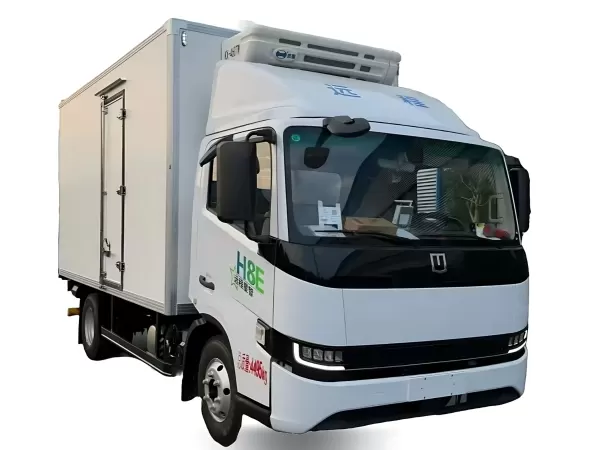 Geely Farizon Electric Refrigerated Truck for Green Cold Chains
Refrigerated Truck
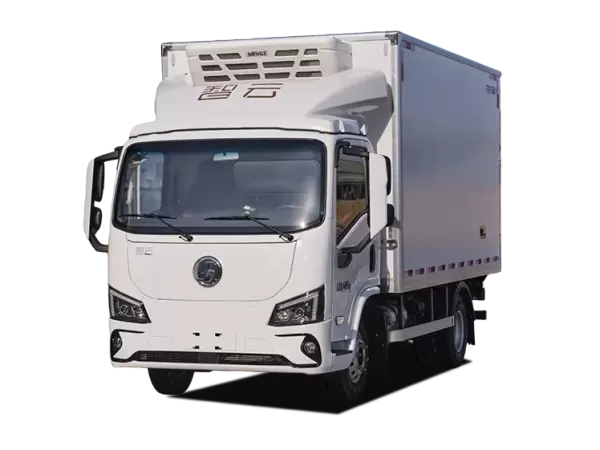 SHACMAN I9 Electric Refrigerated Truck 4x2 Zero Emission Cold Chain
Refrigerated Truck
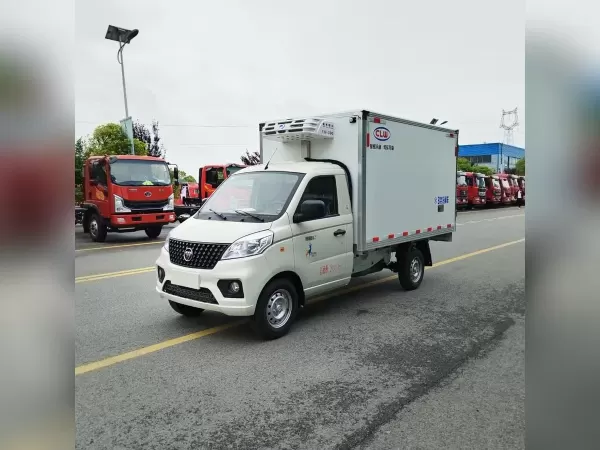 FOTON Mini Refrigerated Truck 4x2 Compact Cold Chain Van
Refrigerated Truck
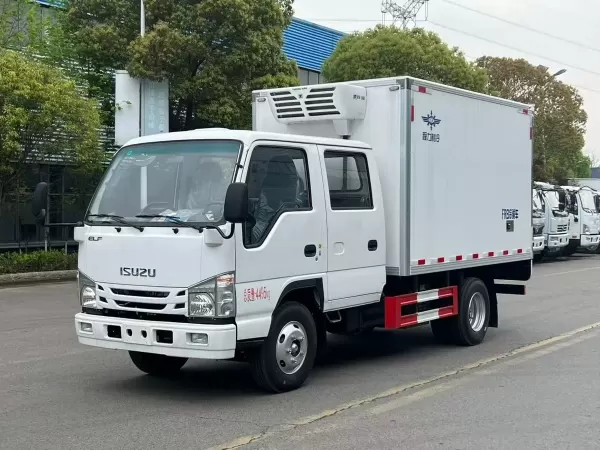 ISUZU 600P Double Cab Refrigerated Truck 4x2 Crew + Cold Cargo
Refrigerated Truck
Tell us your truck model and quantity — an engineer replies within 12 hours with a factory-direct price.
Tell us the model and your requirement — an engineer replies within 12 hours, factory direct.