A truck mounted crane is bought for a lifting duty, not for a tonnage badge. The number on the boom — 8 tonne, 12 tonne, 16 tonne — describes the maximum load at the shortest radius with the outriggers fully extended on firm, level ground. At the radius where the load actually sits, the same crane may be rated for a small fraction of that figure. Buyers who order by tonnage and read the load chart afterwards usually end up with a crane that cannot reach the job, or a carrier that cannot legally carry both crane and cargo. Factory prices in 2026 run from roughly USD 42,000 for a 6.3 tm knuckle boom on a light 4x2 flatbed to more than USD 180,000 for a 30 tm crane on a heavy 8x4 carrier. This guide explains how lifting moment, geometry, carrier and body fit together, how to read the load chart, what the outriggers need from the ground, the safety devices an inspector will test, the certification routes, the price bands, running costs and the inspection schedule.
Lifting moment is capacity multiplied by working radius, expressed in tonne-metres (tm). A 40 tm crane can lift about 4 t at 10 m or 2 t at 20 m, subject to the load chart and the outrigger configuration. An 8 tm crane lifts roughly 4 t at 2.5 m and about 1 t at 8 m. Two cranes both sold as "10 tonne" can therefore behave very differently once the boom extends, because the boom length, the section count and the outrigger span differ. Four terms decide the specification, and a quotation that does not state them cannot be compared:
Start every enquiry with three numbers: the load in tonnes including the rigging, the radius at which it must be placed, and the height it must clear. A crane sized from those three numbers is cheaper than a crane sized from a catalogue headline and then re-ordered.
The two boom families do different work, and the choice changes the operator's position, the body layout and the price more than the tonnage badge does.
| Item | Straight boom | Knuckle boom |
|---|---|---|
| Geometry | Extends in a line; telescope sections along one axis | Folds at a knuckle; main boom plus jib, compact when stowed |
| Reach at height | Longer for the same boom weight; fastest over open ground | Reaches over and under obstructions; shorter straight-line reach |
| Working envelope | Flatbed loading, steel and timber handling, precast placement, general construction | City delivery with side lifts, utility and telecom work, yards with low headroom |
| Attachments | Hook and, with modification, a basket | Grabs, augers, clamshells, man baskets, winches — the natural platform for below-hook tools |
| Maintenance load | Fewer joints and pins to inspect | More joints, more pins, more greasing points |
| Price for the same capacity | Baseline | Roughly 10–20 percent higher |
Both types are available with top-seat controls, cable remote or radio remote; the control choice affects where the operator stands and how the load is kept in view. If a single truck must load and unload its own cargo on public roads, a knuckle boom mounted behind the cab is usually the better fit. If the crane mainly lifts at a fixed site with long reach, a straight boom gives more radius per dollar.
CLW mounts these cranes on truck mounted crane chassis from ISUZU, DONGFENG, SINOTRUK HOWO and SHACMAN, in straight and knuckle configurations from 6.3 tm to 30 tm. Where a fleet already runs a cargo and dump truck or a refrigerated truck on the same carrier, one chassis family keeps training and spare-parts stock simple.
The load chart is the only document that states what the crane may lift, and it is read in four dimensions: radius, boom length, boom angle and outrigger configuration. Most charts show separate columns for full outriggers, half outriggers and free-on-wheels operation, and the capacity for "on wheels" can be a small fraction of the fully supported figure. A quotation that says "12 t crane" without the chart is a quotation for a maximum capacity that may exist only at 2 m.
| Radius | Rated capacity | What it typically lifts | Note |
|---|---|---|---|
| 2.5 m | 12.0 t | Transformer, generator set, concrete block | Structural limit, not hydraulic limit |
| 5 m | 7.0 t | Steel bundles, precast panels, machinery | The working radius for most flatbed loading |
| 8 m | 4.6 t | Roof-mounted plant, HVAC units, poles | Typical utility and telecom lift |
| 10 m | 3.7 t | Containers, palletised goods, site material | About 4 t theoretical, derated by the chart |
| 15 m | 2.4 t | Light plant, signage, second-storey placement | Boom length and deflection start to matter |
| 20 m | 1.6 t | Light loads at the edge of reach | Wind area of the load, not weight, may govern |
Read the chart against the jobs you actually do, and mark the lifts you perform weekly on it. If three of those jobs fall outside the envelope, the crane is too small whatever its tonne badge says. If they fall inside with 20 percent margin, the crane is right-sized. Always add the weight of the rigging, the slings and any attachment to the load; a 500 kg grab on a 4.6 t lift is a 5.1 t lift, and the chart does not care that the grab is "part of the crane".
The chassis has to carry the crane, the body and the cargo, and it has to be stable when the boom is out. A crane mounted behind the cab shifts weight rearward, so the rear axle and the frame reinforcement are the first things to check. The outrigger spread determines the load each pad puts into the ground, and that number — not the crane capacity — decides whether the truck can set up on a sidewalk, a verge or a yard with a basement underneath.
| Crane class | Typical carrier | Outrigger spread | Pad load per leg | Body and cargo left |
|---|---|---|---|---|
| 6.3–8 tm | 4x2 light, GVW 7.5–10 t | 2.5–3.5 m each side | 3–6 t | 4.5–6 m flatbed, 2–4 t cargo |
| 10–12 tm | 4x2 medium, GVW 10–16 t | 3.5–4.5 m each side | 6–10 t | 5.5–7 m flatbed, 4–6 t cargo |
| 16–20 tm | 6x4, GVW 18–25 t | 4.5–5.5 m each side | 10–15 t | 6–8 m deck, 6–9 t cargo |
| 25–30 tm | 8x4, GVW 28–40 t | 5.5–6.5 m each side, front outriggers | 15–20 t | 7–9 m deck, 10–14 t cargo |
Pad loads are the most underestimated figure in the quotation. A 15 t pad load on asphalt is fine; the same load on a grass verge, a paved yard over a drain, or a basement roof is a collapse waiting for the first lift. Ask for the maximum pad load per leg and the recommended pad size, then carry spreader plates or timber mats on the truck. Also check the frame: a crane mounted on an unreinforced chassis rail cracks at the mounting bolts within a season, which is why the body builder should supply the reinforcement drawing along with the crane.
The body is not a neutral platform: it sets the deck length, the cargo capacity left after the crane, and how the crew secures the load. Four configurations cover most orders.
| Configuration | Deck | Typical use | What to specify |
|---|---|---|---|
| Flatbed with side rails | 4.5–9 m steel or aluminium deck, drop sides | General cargo, building material, machinery, precast | Deck floor thickness, lashing points every 1.5 m, side rail height |
| Cargo body with crane behind cab | Enclosed or open cargo box, crane at the front bulkhead | Delivery fleets that self-load, utility material, pallets | Crane mounting position, body reinforcement, door clearances |
| Service and maintenance body | Tool cabinets plus work bench, crane at the rear | Municipal, utility and fleet service trucks | Cabinet locks, drawer slides, workbench height, lighting |
| Heavy carrier deck | 7–9 m reinforced deck with outrigger tunnels | Plant hire, construction logistics, heavy attachments | Deck loading, outrigger beam routing, ramps and winch provision |
Whichever configuration is chosen, the crane and the body should be designed together. A crane ordered separately and fitted to an existing deck usually ends up with the mounting bolts through a single skin of steel, the outrigger beams crossing the cargo space, and the deck rated for a load it can no longer carry.
A loader crane is lifting equipment, and the devices that protect the crew are specified on paper before they are tested on site. The specification should include a rated-capacity limiter or overload protection that stops the crane before the structural limit, an angle and length sensor feeding the same system, outrigger position sensing that prevents operation until the legs are deployed and locked, a level indicator, an emergency stop at both the operator station and the ground, and a boom lock for road travel with a switch that prevents driving while the boom is out of its cradle. Where personnel lifting is permitted, the man basket needs its own rated attachment, a gate that cannot open in flight, and a documented procedure that complies with the standard the market applies.
Two items are frequently missing and always noticed by auditors: a load moment indicator with a calibration certificate, and a logbook in which every inspection, repair and test is recorded. A crane without its logbook cannot prove it is safe, and a crane without a calibrated limiter cannot prove it will stop.
Below-hook attachments change the duty and the rating. A grab, an auger, a clamshell or a winch adds weight at the hook, which reduces the usable capacity exactly as a heavier load would; it also changes the load's centre of gravity and, for grabs, the wind area. Ask for the crane's attachment compatibility list and the derated capacity with each tool fitted, and remember that the attachment's own rating may be lower than the crane's.
Personnel lifting is a separate regime. In most markets lifting people with a crane is only permitted with a purpose-built man basket, a rated and marked attachment point, a fall-protection harness anchored inside the basket, and an operating procedure that follows the market's standard — EN 14502-1 in Europe, and national equivalents elsewhere. Some markets prohibit it outright. If personnel lifting is part of the duty, say so at quotation stage: a crane ordered for material handling and later used for people is a compliance failure waiting for an accident.
A crane truck carries two approval tracks like any other special vehicle: the vehicle, and the lifting equipment. The vehicle needs the usual homologation, emissions and weight documents. The crane needs conformity with the loader-crane standard the market applies — EN 12999 in Europe and many export markets — plus, in most jurisdictions, a periodic inspection regime with a competent person or an accredited body, a load test at installation, and a certificate that names the machine's serial number.
| Market | Vehicle track | Lifting equipment track | Practical note |
|---|---|---|---|
| Saudi Arabia and the Gulf | SASO / SABER (KSA), ESMA (UAE), GSO standards | EN 12999 basis plus national lifting-equipment inspection | Arabic load chart, manuals and information plate |
| Kenya, Tanzania, Uganda | KEBS PVoC, TBS, UNBS pre-shipment inspection | EN 12999 basis; national lifting inspection and load test on arrival | Inspection before loading; the certificate must name the shipped crane |
| Nigeria and West Africa | SONCAP certificate and pre-shipment inspection | National lifting inspection; load test certificate | Allow time for the client's own safety review |
| Brazil, Mexico and Latin America | INMETRO (Brazil), NOM (Mexico), national homologation elsewhere | National lifting-equipment rules and periodic inspection | Spanish or Portuguese load chart and manuals |
| Russia, CIS and EAEU | EAC conformity, TR CU 018/2011 | EAC plus the national crane inspection rules (Rostechnadzor regime) | Russian load chart and manuals; cold-climate hydraulic oil |
| Right-hand-drive markets | National homologation, often with local inspection | National lifting inspection | Order RHD at the factory; the crane position and body layout change with the steering side |
The bands below are factory-direct, FOB China, for a standard build with the crane, flatbed body, outriggers and basic safety devices, early 2026. Boom type, control system, attachment package, deck specification and right-hand drive move the figure.
Compare the same line items: crane make and lifting moment, boom section count, control system, outrigger spread and pad size, deck thickness and lashing points, frame reinforcement drawing, safety device list and load chart with the delivered serial number. A quotation that gives only "16 t crane truck, USD 110,000" cannot be compared, because the two cranes may differ in lifting moment, in outrigger span and in whether the deck can carry the cargo the crane was bought to load.
Purchase is roughly a third of the five-year bill. The table is an illustrative model for a 16 tm crane on a 6x4 carrier covering 40,000 km a year and 700 crane hours, with annual lifting inspection included. Your rates will differ; the order of the items rarely does.
| Item | Basis | Five-year total (USD) | Share |
|---|---|---|---|
| Purchase and delivery | USD 105,000 FOB plus freight and duty estimate | 113,000 | 32 % |
| Vehicle fuel | 40,000 km at 30 L/100 km, USD 1.10 | 66,000 | 19 % |
| Crane inspection and load test | Annual statutory inspection, load test at installation and after repairs | 7,500 | 2 % |
| Crane service | Hydraulic oil and filters, seals, hoses, pins and bushes, limiter calibration | 11,000 | 3 % |
| Chassis service and tyres | Scheduled service, two tyre sets, brake and suspension work | 10,000 | 3 % |
| Insurance and registration | Lifting-equipment cover, licensing | 11,000 | 3 % |
| Operator labour | Salary and overhead, not included here | — | — |
The lesson is not the exact total but the pattern: fuel dominates, and the crane items that protect the certificate — inspection, limiter calibration, pins and bushes — are small enough that skipping them is tempting and expensive. A crane that loses its inspection certificate stops earning, whatever its condition.
Send these twelve answers with the destination port and the job list, and a builder can return a line-item quotation rather than a range.
| # | Input | What to state | Why it changes the quotation |
|---|---|---|---|
| 1 | Maximum load | Tonnes including rigging and attachment | Sets the crane class |
| 2 | Radius and height | Radius and lift height for your heaviest and your furthest jobs | Sets the lifting moment and boom length |
| 3 | Job list | The five lifts you perform most often | Decides straight or knuckle boom |
| 4 | Attachments | Grab, auger, winch, basket or hook only | Changes the hydraulic package and derates capacity |
| 5 | Personnel lifting | Whether people will be lifted and under which standard | Adds a compliant basket and procedure |
| 6 | Body configuration | Flatbed, cargo body, service body or heavy deck | Sets deck length, reinforcement and cargo capacity |
| 7 | Cargo carried | Weight and volume carried with the crane on board | Sets carrier GVW and axles |
| 8 | Ground conditions | Asphalt, verge, yard, basement deck, slope | Sets pad size and spreader-plate requirement |
| 9 | Route | Street width, gates, bridges, tunnel restrictions | Sets chassis length and outrigger layout |
| 10 | Controls | Top seat, cable remote or radio remote | Changes price and operator position |
| 11 | Driving side and registration | Left- or right-hand drive, GVW class and local approval | Changes layout and homologation documents |
| 12 | Service | Spare parts kit, operator training and warranty terms | Affects price and uptime |
CLW builds to MIIT catalogue requirements in an ISO-certified factory. Export files include certificate of origin, commercial invoice, packing list, bill of lading, crane test report and load chart on request. Standard crane trucks up to 20 tm take 30–45 working days after deposit and drawing approval; 25–30 tm units and heavy decks take 45–65 working days. Attachments and radio controls add a week or two.
Factory acceptance inspection should include a functional test of every safety device, a load test at the rated capacity with the chart supplied, an outrigger deployment test, and a driving test with the boom in its cradle. If travel is not possible, ask for video evidence of the load test and the limiter calibration. Small units ship on a flat rack or by RoRo; 6x4 and 8x4 crane trucks normally move by RoRo. More body types are covered in the buying guides.
| Interval | Checks | Parts to keep in stock |
|---|---|---|
| Before every shift | Outrigger pads and pins, hydraulic hoses for chafing, boom lock and cradle, hook latch, limiter display, load chart in the cab, warning lights | Hose repair kit, fuses, lamps, pads |
| Every 250 crane hours | Hydraulic oil level and contamination, filter, cylinder rods, pin and bush wear, turret bolts, structure for cracks, greasing schedule | Filter set, hydraulic oil, seals, pins |
| Every 10,000 km | Chassis service, brakes, suspension, deck fixings, mounting bolts, frame reinforcement for cracks | Filters, brake pads, grease |
| Annually | Statutory lifting inspection, load test as required, limiter calibration check, structural inspection of boom, turret and frame reinforcement | Calibration service, gaskets, replacement hoses |
| After any structural repair | Load test and certificate renewal before the crane returns to work | Test service, replacement pins and bushes |
Most crane incidents start on the ground. Outriggers on a slope, a verge, a drain cover or a basement deck will sink or collapse, and the truck follows. Use spreader plates sized for the stated pad load, set up on ground you have looked at, keep the legs away from trenches and manholes, and re-check the level indicator after the first lift. Never operate with the legs half-extended or the crane on wheels unless the chart explicitly permits it.
Wind matters more than most operators expect, because it acts on the load's area rather than its weight; a panel, a sign or an empty container can govern the lift on a day when the weight is well inside the chart. Stop when gusts exceed the crane's rated wind speed, and never use the crane to drag a load sideways. For personnel lifting, the basket is not a shortcut for a missing platform: it needs its rated attachment, the harness anchor, the gate and the written procedure, and it needs a trained operator who has rehearsed the descent. A crane that is safe on paper still injures people when the crew is in a hurry.
Send your heaviest lift, its radius and height, the jobs you perform weekly and your destination port through the contact page to receive a configuration with the load chart, the pad load calculation and a line-item quotation. If you are still comparing body types, read the rest of our buying guides first: on the same chassis a crane truck, a tipper and a tanker are different machines, and the lifting specification usually matters more than the badge on the grille.
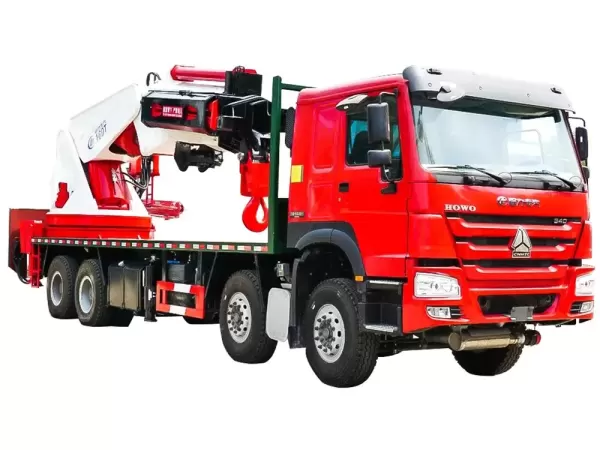 HOWO 8x4 400HP with 35-Ton Crane for Heavy Project Lifts
Truck Mounted Crane
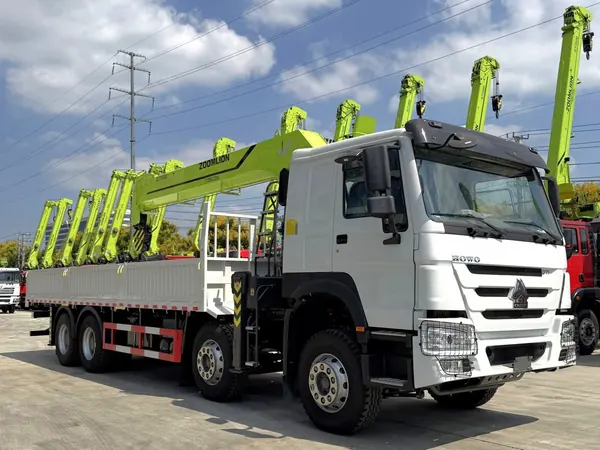 14 Ton Crane Truck for Sale – HOWO 8x4 with ZOOMLION 5-Section Boom
Truck Mounted Crane
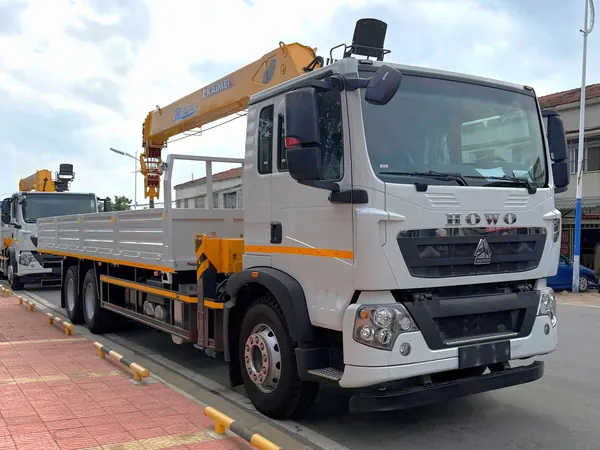 12 Ton Crane Truck for Sale – HOWO T5G 6x4 with KAIMEI Boom
Truck Mounted Crane
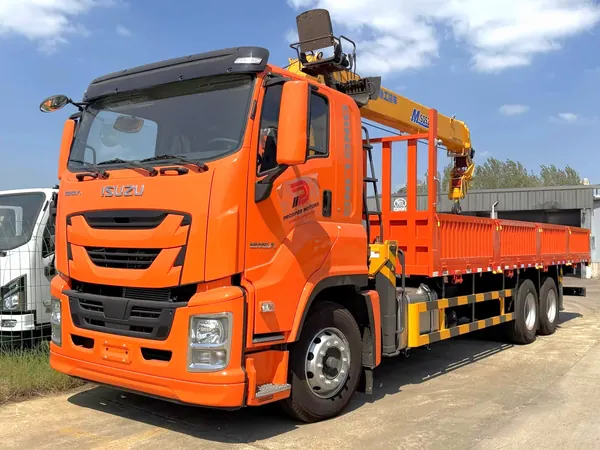 ISUZU GIGA 6x4 10 Ton XCMG Truck Mounted Crane for Sale with 4-Section Boom and 8.5 m Dropside Bed
Truck Mounted Crane
Tell us your truck model and quantity — an engineer replies within 12 hours with a factory-direct price.
Tell us the model and your requirement — an engineer replies within 12 hours, factory direct.