An aerial bucket truck is a working platform first and a truck second. The boom, the bucket, the outriggers and the interlocks decide whether a crew can work safely at height; the chassis only carries them to the site. Buyers who compare cab badges and engine horsepower before they compare working height, insulation class and stability will usually pay twice: once for the vehicle and again for the retrofit that the original specification should have included.
The names overlap because the trade uses them by habit rather than by definition. Aerial work vehicle is the category term used in catalogs and registration documents. Bucket truck and aerial lift truck usually mean a truck-mounted boom with a single or double bucket, most often for utility line work. Cherry picker describes a smaller articulated unit used by municipal, signage and facilities teams, and manlift is the general American term for a mobile elevating work platform. When a supplier quotes you, insist on the numbers rather than the label: working height, platform height, maximum outreach, bucket capacity and insulation class.
Working height is the figure most often inflated in conversation. It is measured from the ground to the platform floor plus roughly 2 m for the operator's reach, so a boom advertised as 20 m gives about 22 m of usable working height. Platform height, the height of the floor itself, is 2 m lower. Ask for both figures in the quotation, and ask which one the factory test certificate records.
Boom geometry is a functional choice, not a styling choice. It determines how fast the crew reaches the work, how much space the truck needs when deployed and how many joints the maintenance schedule has to inspect.
A telescopic boom is faster on a long, clear reach. An articulated boom costs more joints to inspect but gets the bucket around a corner or over a roof line. For utility work, the insulation specification comes first, then the boom type, then the chassis. For municipal work, the opposite order is usually correct: route width and parking determine the chassis, and the boom follows.
Standard CLW working heights run 12, 14, 16, 18, 20, 25, 28, 33 and 45 m, with bucket capacities of 200 to 400 kg and one or two work positions. Larger platforms are available as special builds, but above roughly 45 m the stability calculation, the outrigger spread and the permitted road width start to constrain where the truck can be used, so confirm the real site access before you specify the tallest boom on the price list.
Chassis sizing follows the boom, not the other way round. A 12 to 16 m articulated unit fits a light 4x2 ISUZU, JMC or DONGFENG carrier. A 20 to 28 m boom needs a heavier 4x2 or 6x4 chassis with a wider outrigger spread and a body built to carry the boom's concentrated load. Units above 33 m are normally built on 6x4 or 8x4 carriers with a stability calculation for the deployed boom. 4x4 chassis are available for utility, forestry and emergency response work where the last kilometre is unpaved.
For distribution and transmission maintenance, the boom and bucket are electrical equipment as well as mechanical equipment. The specification should state the insulation class, the test voltage, the leakage current limit, the test method and the interval between periodic tests. Where the buyer's market follows IEC 61057 or an equivalent national standard for live-working aerial devices, the design should be reviewed against that standard before production, and the factory test record should travel with the vehicle.
Do not accept "insulated" as a specification. Ask for the test certificate for the actual boom that will ship, not a generic brochure. Ask whether the bucket has a conductive liner or a bare FRP shell, how the boom is grounded, whether the chassis is isolated from the boom, and what the manufacturer requires for re-testing after a repair. A utility that cannot produce the test file for its own safety committee has bought a very expensive access platform rather than a live-line tool.
Height access equipment is only as good as its interlocks. The specification should include:
Ask for the load chart, the outrigger force diagram and the factory test report with the quotation. These are the documents a safety officer and a registration authority will ask for, and they are difficult and expensive to add after the vehicle has been built. If a supplier cannot provide them before the order, the price is not the only thing that is uncertain.
The boom is only half of the working vehicle. A utility crew needs seats for the operator and helpers, lockable storage for tools, harnesses and test equipment, a rear work area for cable and connectors, and a safe place for traffic cones and signs. A municipal or signage crew needs ladders, a lighting kit and a compact body that can park in a residential street. Configure the body around the daily job, then check the result against the permitted axle loads and the registration class.
The following bands are factory-direct, FOB China, for standard specifications and exclude local taxes, freight and any special insulation or body work:
Working height, boom type, insulation class, chassis brand, bucket capacity and a second work position drive the price. A like-for-like comparison should list boom sections, working height, bucket load, outrigger span, chassis model, drive type and safety devices line by line. A quotation that gives one total figure for "an aerial work truck" cannot be compared with another, and it will usually hide the items that are cheapest to omit and most expensive to add later.
Lead time is typically 20 to 35 working days for standard 12 to 25 m units and 35 to 55 working days for 30 to 45 m or insulated utility builds, counted from drawing approval and deposit. Small and medium units ship on flat racks or in containers; the largest booms and fire aerials usually ship by RoRo. Before shipment, inspect the finished unit with the boom cycled through its full range: outriggers set and interlock tested, boom extended and retracted, bucket controls and ground controls operated, emergency lowering demonstrated and the insulation test record checked against the serial number.
The shipment should include the commercial invoice, packing list, bill of lading, certificate of origin, vehicle certificate, boom load test and insulation test records, operator manual, maintenance schedule and spare-parts list. Where the destination requires EN 280, OSHA or an equivalent national standard, review the design against that standard before production and keep the technical file for local approval.
How high can an aerial bucket truck reach? CLW builds standard booms from 12 m to 45 m working height, and larger special builds on request. Check the working height definition and the site access, not only the headline figure.
What does an aerial lift truck cost? Roughly USD 35,000 to 55,000 for a 12 to 16 m articulated unit and USD 100,000 to 160,000 for a 33 to 45 m utility or heavy boom, factory-direct and before freight. Insulation class and chassis choice move the price more than the boom length alone.
Can it be used for live-line work? Only if the boom and bucket are built and tested for that duty, with a stated insulation class and test record. A standard non-insulated platform must not be used on or near live conductors.
Start from the aerial work vehicle range and the aerials fire truck and inspection and maintenance vehicle pages, then send your working height, boom type, insulation requirement, chassis preference, site access and destination port through the contact page. Our Africa market guide explains the conformity routes and ports for that region. We will return a specification proposal and a line-item factory quotation, usually within 12 hours.
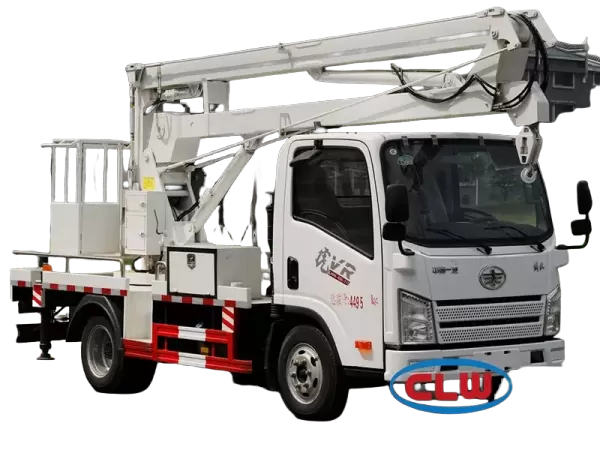 FAW 12 meters Aerial work vehicle
Aerial Work Vehicle
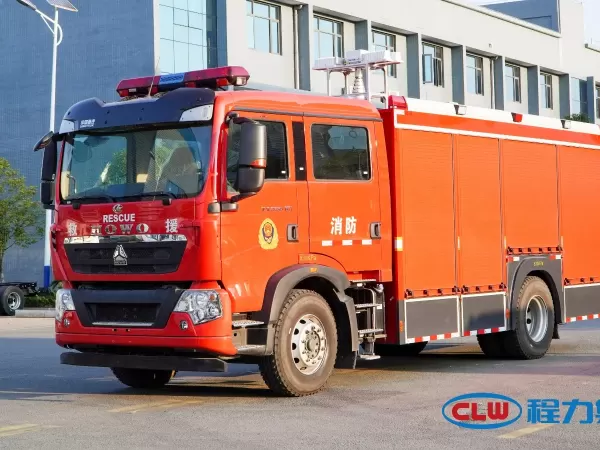 SINOTRUK HOWO 4X2 Fire Utility Truck for Fire Brigade Support
Fire Fighting Truck
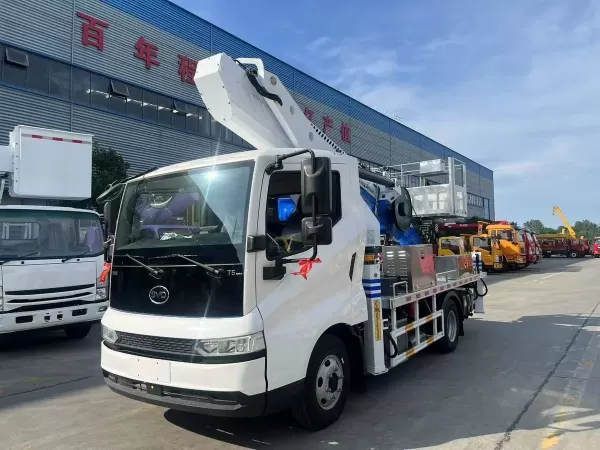 New Product 33m BYD T5 Distance 1000KM DM Aerial Platform Truck | EREV Hybrid Man Lift
Aerial Work Vehicle
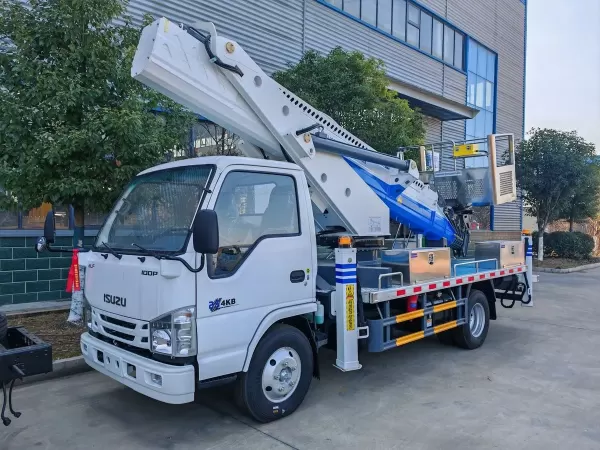 ISUZU 100P 4x2 Aerial Work Truck 120HP Telescopic Boom Cherry Picker Bucket Truck
Aerial Work Vehicle
Tell us your truck model and quantity — an engineer replies within 12 hours with a factory-direct price.
Tell us the model and your requirement — an engineer replies within 12 hours, factory direct.