An aerial bucket truck is a working platform first and a truck second. The boom, the bucket, the outriggers and the interlocks decide whether a crew can work safely at height; the chassis only carries them to the site. Buyers who compare cab badges and engine horsepower before they compare working height, insulation class and stability usually pay twice: once for the vehicle, and again for the retrofit that the original specification should have included. Factory prices in 2026 run from about USD 45,000 for a 14 m municipal unit on a light 4x2 chassis to more than USD 180,000 for a 45 m insulated utility truck, and the insulation certificate, outrigger spread and deck payload explain most of the difference. This guide covers the boom types, the height-and-chassis calculation, the insulation file a utility will ask for, the interlocks, the deck payload budget, the conformity documents, the price bands, running costs and the inspection schedule.
The names overlap because the trade uses them by habit rather than by definition. Aerial work vehicle is the category term used in catalogues and registration documents. Bucket truck and aerial lift truck usually mean a truck-mounted boom with one or two buckets, most often for utility line work. Cherry picker describes a smaller articulated unit used by municipal, signage and facilities teams, and manlift is the general North American term for a mobile elevating work platform. When a supplier quotes you, insist on the numbers rather than the label: working height, platform height, maximum outreach, bucket capacity and insulation class.
Working height is the figure most often inflated in conversation. It is measured from the ground to the platform floor plus roughly 2 m for the operator's reach, so a boom advertised as a 20 m unit gives about 22 m of working height. Platform height — the floor itself — is 2 m lower. Ask for both figures in the quotation, and ask which one the factory test certificate records. A tender that asks only for "20 m" will be answered with whichever figure makes the offer look best.
Boom geometry is a functional choice, not a styling choice. It determines how quickly the crew reaches the work, how much space the truck needs when deployed, and how many joints the maintenance schedule has to inspect.
| Type | Geometry | Typical working height | Deployment footprint | Best for |
|---|---|---|---|---|
| Telescopic bucket truck | Straight, multi-section boom extending in line | 16–45 m | Two outriggers each side, wide spread at the tallest heights | Street lighting, signage, facades, tree work with an unobstructed approach |
| Articulated boom lift | Jointed boom folding up and over obstacles | 12–28 m | Compact; the boom reaches over parked cars and street furniture | Dense streets, bridges, canopies, industrial plants where a straight boom cannot get close |
| Insulated utility truck | Telescopic or articulated, dielectric boom and bucket | 14–45 m | As per geometry, with chassis isolated from the boom | Live-line distribution work; specified by the utility's standard, not a catalogue page |
| Cherry picker / small manlift | Articulated, single bucket | 12–16 m | Light 4x2 chassis, tight outrigger pattern | Municipal maintenance, signage, facilities, street furniture |
| Special-purpose platform | Configured around the task | Task-dependent | Task-dependent | Lighting towers, camera and inspection platforms, window-cleaning booms, fire-access aerials |
A telescopic boom is faster on a long, clear reach. An articulated boom costs more joints to inspect but puts the bucket around a corner or over a roof line. For utility work the order of decisions is insulation specification first, then boom type, then chassis. For municipal work the opposite order is usually correct: route width and parking determine the chassis, and the boom follows.
CLW builds these units on aerial work vehicle chassis from ISUZU, JMC, DONGFENG, SINOTRUK and SHACMAN, with working heights of 12, 14, 16, 18, 20, 25, 28, 33 and 45 m and bucket capacities of 200–400 kg in one or two work positions. Larger platforms are available as special builds, but above roughly 45 m the stability calculation, the outrigger spread and the permitted road width start to constrain where the truck can be used — confirm real site access before ordering the tallest boom on the list.
Chassis sizing follows the boom, not the other way round. A 12–16 m articulated unit fits a light 4x2 ISUZU, JMC or DONGFENG carrier. A 20–28 m boom needs a heavier 4x2 or 6x4 chassis with a wider outrigger spread and a body built to carry the boom's concentrated load. Units above 33 m are normally built on 6x4 or 8x4 carriers with a stability calculation for the deployed boom. 4x4 chassis are available for utility, forestry and emergency response work where the last kilometre is unpaved.
Outreach matters as much as height and is quoted less often. A boom that reaches 20 m vertically may reach only 8–10 m horizontally at full height, and a crew that has to reposition the truck twice to cross one road loses more time than a taller boom would have saved. Ask for the working envelope — the height-and-outreach curve — with the quotation, and mark on it the jobs you actually plan to do.
| Working height | Typical chassis | Outrigger spread | Bucket capacity | Deck payload for tools and crew |
|---|---|---|---|---|
| 12–16 m | 4x2 light, GVW 7.5–10 t | 2.0–2.6 m each side | 200 kg, one bucket | 600–900 kg |
| 18–22 m | 4x2 medium, GVW 10–16 t | 2.6–3.4 m each side | 200–250 kg, one or two buckets | 1,000–1,600 kg |
| 25–28 m | 4x2 heavy or 6x4, GVW 16–25 t | 3.4–4.2 m each side | 250–300 kg, two buckets | 1,600–2,500 kg |
| 33 m | 6x4, GVW 25–31 t | 4.2–5.0 m each side | 270–350 kg, two buckets | 2,000–3,000 kg |
| 45 m | 8x4, GVW 31–40 t | 5.0–6.0 m each side, plus front outriggers | 300–400 kg, two buckets | 2,500–3,500 kg |
The table is a planning guide, not a catalogue. Every build must come with its own stability calculation at the deployed boom angle, and the outrigger pad load must be checked against the ground the crew will actually stand on: a pad that is fine on asphalt sinks into a verge. Ask for the maximum pad load in kilograms, because that number decides whether the crew needs spreader plates or timber mats under the legs on soft ground.
For distribution and transmission maintenance, the boom and bucket are electrical equipment as well as mechanical equipment. The specification should state the insulation class, the test voltage, the leakage-current limit, the test method and the interval between periodic tests. Where the buyer's market follows IEC 61057 or an equivalent national standard for live-working aerial devices, the design should be reviewed against that standard before production, and the factory test record should travel with the vehicle.
Do not accept "insulated" as a specification. Ask for the test certificate for the actual boom that will ship, not a generic brochure. Ask whether the bucket has a conductive liner or a bare FRP shell, how the boom is grounded, whether the chassis is isolated from the boom, and what the manufacturer requires for re-testing after a repair. A utility that cannot produce the test file for its own safety committee has bought an expensive access platform rather than a live-line tool.
| Item | What to ask for | Why it matters |
|---|---|---|
| Insulation class and rating | Class stated against the national or IEC 61057 basis, with the rated distribution voltage | Defines which lines the unit may work on at all |
| Factory dielectric test | Test voltage, duration, leakage current and pass criteria, on the certificate for the delivered boom serial number | A brochure certificate does not prove anything about your boom |
| Bucket construction | FRP shell or lined bucket, wall thickness, liner material and fixings | A conductive liner turns the bucket into a path to earth |
| Bonding and isolation | How the boom is bonded, whether the chassis is isolated, where the test point is | Decides what the periodic test actually measures |
| Periodic test interval | Manufacturer's interval and method, plus the record template | Utilities are audited on test records, not on intentions |
| Post-repair rules | Which repairs require a full dielectric re-test, and who may sign it | A repaired boom without re-test is an unrated boom |
Height access equipment is only as good as its interlocks, and the interlocks are specified on paper long before the crew meets them in the field. The specification should include outrigger position sensing that prevents boom deployment until all legs are set and locked; level indication with an alarm that stops the boom outside the permitted tilt; an overload sensor on the bucket load and the boom moment; an emergency stop in the bucket and at the ground station; a manual lowering or emergency descent function that works without the engine; and upper and lower limit switches that prevent the boom from reaching the chassis, the cab or the operator's position. For utility units, add an upper-limit switch linked to the approach distance of the rated voltage, and a bucket insulation test point.
Two further requirements are easy to forget and expensive to add later. The first is a boom-lock or transport cradle rated for road travel, with a switch that prevents the chassis from moving while the boom is out of its cradle. The second is a documented rescue procedure for an operator who cannot lower the bucket himself, with the equipment on board to perform it. Both are checked by safety auditors, and neither can be improvised on site.
Related fleet types share chassis and service networks: a cargo and dump truck or a road construction truck on the same carrier simplifies driver training and spare-parts stock for a municipal fleet that runs several body types.
The chassis carries the boom, the deck, the crew and the tools, and the deck payload is the figure that disappears first. Start from the permitted axle loads, subtract the chassis, the boom and the body, and what remains has to cover the crew, their harnesses, tools, cable drums, transformers, signs, lighting heads and the water or fuel some crews carry. A crew of three with full PPE weighs about 300 kg; a cable drum, a transformer and a tool box can easily add another 600–900 kg. A deck rated at "1,000 kg" that is already carrying a 700 kg boom is a deck with 300 kg left.
| Item | Weight | Note |
|---|---|---|
| Chassis kerb weight | 7,800 kg | 4x2 heavy carrier with fuel and driver |
| Boom and turret | 4,200 kg | Includes the bucket and the hydraulic system |
| Body, deck and outriggers | 2,600 kg | Steel deck, cabinets, outrigger legs and pads |
| Remaining payload at GVW 18 t | 3,400 kg | What is left for people, tools and material |
| Crew of three with PPE | 300 kg | Two in the bucket, one on the ground |
| Tools, cable drum, transformer | 900–1,500 kg | The variable that decides whether the truck is legal on the day |
The practical answer is to specify the deck for the heaviest material the crew actually carries and to leave 10 percent margin, because nobody weighs a cable drum before loading it. Body configuration follows the same logic: lockable cabinets sized for the tools the crew uses daily rather than for the ones it uses once a year, a work bench at the rear for terminations, a traffic-cone bracket and a warning-light bar, and a step arrangement that lets a person in a harness board safely.
An aerial work vehicle is checked on two tracks: the vehicle registration and the platform safety standard. The vehicle needs the usual homologation, emissions and labelling documents for its class and GVW. The platform needs conformity with the mobile elevating work platform standard the market applies — EN 280 in Europe and many export markets, ANSI A92.2 in North America, and national equivalents elsewhere — covering stability, structural strength, interlocks and the information plate on the machine. A unit that satisfies the truck authority but not the platform standard is a truck that cannot be insured for work at height.
| Market | Vehicle track | Platform and electrical track | Practical note |
|---|---|---|---|
| Saudi Arabia and the Gulf | SASO / SABER (KSA), ESMA (UAE), GSO standards | EN 280 basis accepted by most operators; utility units need the insulation file | Arabic information plate and manuals; high-ambient cooling package |
| Kenya, Tanzania, Uganda | KEBS PVoC, TBS, UNBS pre-shipment inspection | EN 280 basis; utility insulation certificate from the manufacturer | Inspection before loading; the certificate must name the shipped serial number |
| Nigeria and West Africa | SONCAP certificate and pre-shipment inspection | EN 280 basis; national utility acceptance | Allow time for the utility's own safety review |
| Brazil, Mexico and Latin America | INMETRO (Brazil), NOM (Mexico), national homologation elsewhere | National MEWP rules, often aligned with ANSI A92.2 or EN 280 | Spanish or Portuguese manuals and information plates |
| Russia, CIS and EAEU | EAC conformity, TR CU 018/2011 | EAC plus the national lift inspection rules | Russian manuals and a cold-climate package |
| Right-hand-drive markets | National homologation, often with local inspection | Utility insulation file and platform certificate | Order RHD at the factory; body and outrigger layout change with the steering side |
The bands below are factory-direct, FOB China, for a standard unit with the boom, deck, outriggers, warning lights and information plate, early 2026. Insulation, 4x4 drive, right-hand drive, extra tool cabinets and special platform equipment move the figure, and a utility-grade insulation file adds engineering time rather than hardware.
Compare the same line items: boom manufacturer and section count, hydraulic pump and valve brand, outrigger type and pad size, deck steel, cabinet specification, insulation class and test evidence, interlock list, information plate standard and delivery drawings. A quotation that gives only "20 m bucket truck, USD 90,000" cannot be compared with another, because the two units may differ by an insulated boom, a stability calculation and two years of service life.
The purchase price is roughly a third of a five-year bill. The table is an illustrative model for a 25 m insulated unit covering 25,000 km a year and 900 boom hours a year, with periodic insulation testing included. Your rates will differ; the order rarely does.
| Item | Basis | Five-year total (USD) | Share |
|---|---|---|---|
| Purchase and delivery | USD 128,000 FOB plus freight and duty estimate | 138,000 | 34 % |
| Vehicle fuel | 25,000 km at 24 L/100 km, USD 1.10 | 16,500 | 4 % |
| Boom inspection and certification | Annual structural and dielectric test, five years | 9,000 | 2 % |
| Hydraulic and mechanical service | Oil and filters, cylinder seals, hose replacement, valve service | 14,000 | 3 % |
| Chassis service and tyres | Scheduled service, two tyre sets | 8,000 | 2 % |
| Insurance, registration and crew training | Annual premiums, licensing and certified operator refresher | 12,000 | 3 % |
| Crew labour | Salaries and overhead, not included here | — | — |
The lesson is not the exact total but the pattern: purchase dominates, and the items that protect the crew — certification, hose replacement, valve service — are cheap relative to the machine. A unit that skips the annual dielectric test saves USD 1,800 a year and loses the right to work on live lines, which is the entire reason the insulated boom was purchased.
Send these twelve answers with the destination port and the utility's own standard where one applies, and a builder can return a line-item quotation rather than a range.
| # | Input | What to state | Why it changes the quotation |
|---|---|---|---|
| 1 | Working height | Height to platform floor and required working height, both in metres | Sets boom sections and chassis class |
| 2 | Outreach | Horizontal reach needed at full working height | Sets boom geometry and deployment footprint |
| 3 | Bucket capacity and positions | Number of buckets, load per bucket, tools carried in the bucket | Sets platform rating and structural design |
| 4 | Insulation | Live-line or not; rated voltage; standard to be certified against | Changes boom material, bucket and test file |
| 5 | Boom type | Telescopic or articulated, and whether overhead obstacles are common | Changes geometry, joints and maintenance |
| 6 | Route and access | Street width, parking, gates, bridges, seasonal road conditions | Sets chassis length, 4x4 need and outrigger spread |
| 7 | Deck payload | Tools, cable drums, transformers and crew you actually carry | Sets deck structure and GVW class |
| 8 | Interlocks | Required list, plus any utility-specific safety features | Changes control system and price |
| 9 | Driving side and registration | Left- or right-hand drive, GVW class and local approval | Changes body layout and homologation documents |
| 10 | Platform standard | EN 280, ANSI A92.2 or the national equivalent | Determines the certificate and information plate |
| 11 | Delivery | Port of discharge and shipping mode, container or RoRo | Changes packing, freight and schedule |
| 12 | Service and training | Spare parts kit, operator training and warranty terms | Affects price and the availability you can expect |
CLW builds to MIIT catalogue requirements in an ISO-certified factory. Export files include certificate of origin, commercial invoice, packing list, bill of lading and inspection report on request. Standard units up to 28 m take 30–45 working days after deposit and drawing approval; 33 m and 45 m units take 45–70 working days, because the stability calculation and boom test come before final assembly. Insulated builds add the dielectric test and certification time.
Factory acceptance inspection is worth the trip on any unit above USD 100,000: deploy the outriggers on a level floor, raise the boom through its full envelope, test every interlock deliberately, and witness the dielectric test if the unit is insulated. If travel is not possible, ask for a video inspection item by item against the interlock list, and for the test certificates in writing with the delivered serial number. Units up to 28 m usually ship on a flat rack or by RoRo; larger booms need RoRo or a heavy-lift deck. More body types are covered in the buying guides.
An aerial unit is inspected on two clocks: the chassis follows kilometres, the boom follows hours and calendar. The boom clock is the one that decides whether the crew may work tomorrow.
| Interval | Checks | Parts to keep in stock |
|---|---|---|
| Before every shift | Outrigger pads and pins, hydraulic hoses for chafing and leaks, boom cradle and lock, bucket floor and gate, harness anchors, emergency descent, warning lights, information plate legible | Hose repair kit, fuses, lamps, pads |
| Every 250 boom hours | Hydraulic oil level and contamination, filter, cylinder rod condition, pin and bush wear, turret bolts, structural welds by visual inspection | Filter set, hydraulic oil, seals, pins |
| Every 10,000 km | Chassis service, tyre condition, outrigger leg action, deck fixings, cabinet latches | Filter set, brake pads, grease |
| Annually | Structural inspection of boom, turret and outriggers; non-destructive testing where the standard requires it; dielectric test on insulated units; interlock function test; stability verification after any repair or welding on the boom | Certification service, gaskets, replacement hoses |
| After any repair to the boom | Full dielectric re-test for insulated units, structural review, new certificate before the unit returns to work | Test service, spare bucket shell if damaged |
Most aerial truck incidents start on the ground rather than in the air. Outriggers on a slope, on a verge, over a basement or over a drain will sink, and the truck follows. Use spreader plates sized for the pad load the manufacturer states, set the legs on ground you have looked at, and re-check the level indicator after the first lift. Never deploy the boom until the interlocks confirm all legs are set and locked.
Weather is a stop-work condition, not a judgement call: stop when the wind rises above the platform's rated limit, stop during lightning within the approach distance of the site rules, and avoid working over traffic without a lane closure. For electrical work, respect the approach distance for the rated voltage, keep the boom and the bucket inside the permitted envelope, and treat every line as live until the utility's own permit says otherwise. Every operator should be trained and certified on the specific machine, harnessed to the designated anchor, and trained in the rescue procedure for a colleague who cannot descend. A platform that is safe on paper still injures people when the crew is in a hurry, which is why the shift checklist is not paperwork.
Send your working height, outreach, live-line requirement and destination port through the contact page to receive a configuration with the working envelope, the stability calculation and a line-item quotation. If you are still comparing platform classes, read the rest of our buying guides first: on the same chassis an aerial truck, a crane truck and a tipper are different machines, and the boom specification usually matters more than the badge on the grille.
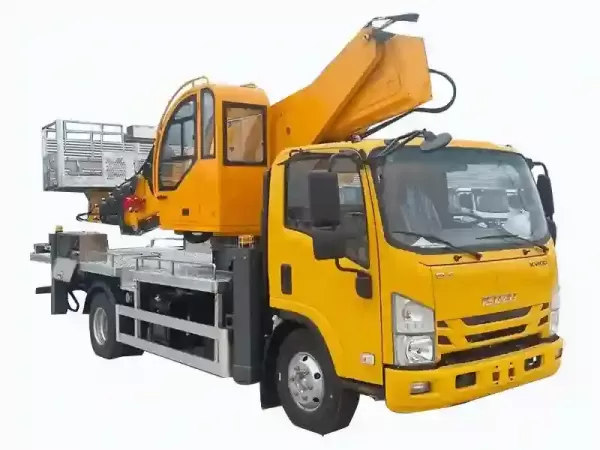 ISUZU 32 m Aerial Platform Truck for Utility Maintenance
Aerial Work Vehicle
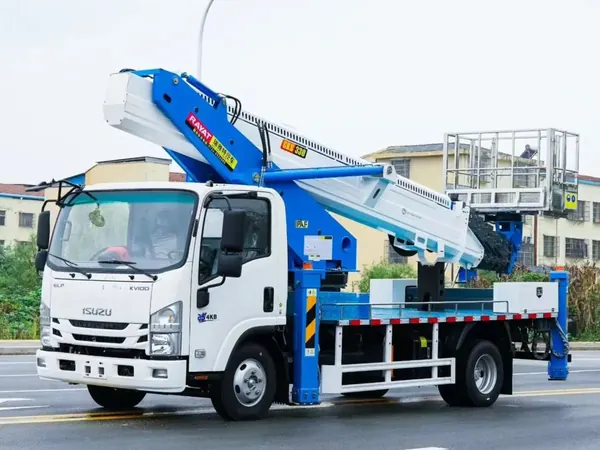 ISUZU ELF 4x2 32m Manlift Bucket Truck for Sale with 200 kg Basket for Street Lighting
Aerial Work Vehicle
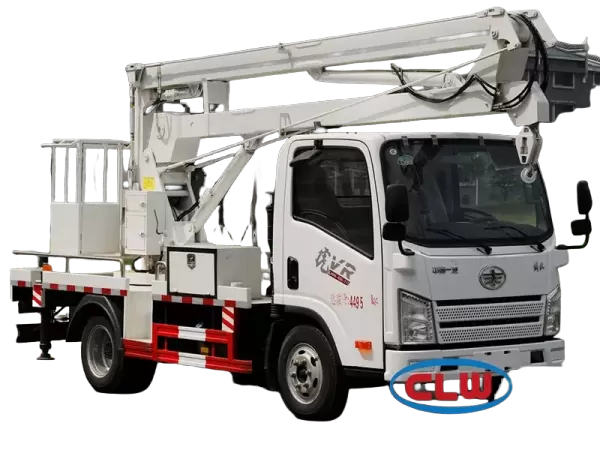 FAW 12 meters Aerial work vehicle
Aerial Work Vehicle
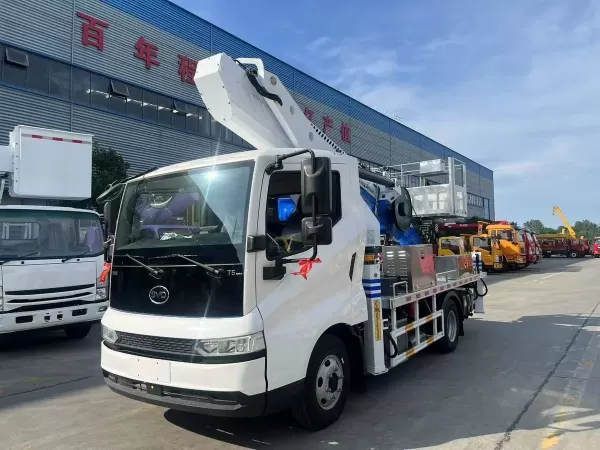 New Product 33m BYD T5 Distance 1000KM DM Aerial Platform Truck | EREV Hybrid Man Lift
Aerial Work Vehicle
Tell us your truck model and quantity — an engineer replies within 12 hours with a factory-direct price.
Tell us the model and your requirement — an engineer replies within 12 hours, factory direct.