A dump truck looks simple: a chassis, a steel body and a hydraulic ram. In practice the body plate, the ram layout and the axle load decide whether the truck earns money for ten years or spends its life in the workshop. The same SHACMAN, SINOTRUK HOWO, DONGFENG or ISUZU carrier can be built as a 5 m³ urban tipper, a 20 m³ construction truck or a 30 m³ mining unit, and the 2026 factory price can differ by a factor of four between them. This guide covers the types, the body and hydraulic choices, the payload and axle arithmetic, the compliance documents your market will ask for, the price bands, the running costs and the maintenance schedule — so that the quotation you sign matches the job you actually run.
Buyers search for dump trucks, tipper trucks, tipper lorries and dumpers, and suppliers use the terms loosely. In this guide a dump truck is a rigid truck with a tipping body that discharges bulk material behind the cab or to one side. That covers sand, gravel, crushed stone, coal, grain, construction waste, slag and mined rock. It does not cover a tractor-trailer tipper, a garbage compactor or a hooklift that swaps open containers; those are separate bodies with different discharge and licensing rules.
The first decision is therefore the duty, not the brand. A truck that leaves a paved yard, runs 20 km and tips into a hopper has different requirements from one that climbs an unpaved mine haul road at full load all day. Write down the route, the material, the daily tonnage and the discharge point before comparing quotations, because every one of those answers moves the body volume, the plate thickness, the ram size and the chassis class — and therefore the price.
Five families cover almost every tender. The table below gives the practical envelope of each; the payload ranges assume local GVW limits that allow them, and the price bands are factory-direct, FOB China, for standard specifications in early 2026.
| Type | Typical chassis | Payload | Body volume | Typical duty | Indicative FOB |
|---|---|---|---|---|---|
| Light urban tipper | 4x2, 7.5–16 t GVW | 3–10 t | 5–10 m³ | Sand, gravel, paving waste, household construction debris; narrow streets and basement access | USD 15,000–25,000 |
| Construction dump truck | 6x4, 25–33 t GVW | 14–20 t | 14–20 m³ | Site clearance, road building, quarry output on partly paved routes | USD 38,000–55,000 |
| Heavy / mining tipper | 8x4, 31–40 t GVW | 20–30 t | 20–30 m³ | Rock, slag, ore and continuous haulage on prepared unpaved roads | USD 50,000–70,000 |
| Side tipper | 4x2 to 8x4 | As chassis class | As chassis class | Road works, rail ballast, narrow sites where reversing to a tip point is unsafe | Add 10–20% |
| Multi-way tipper | 4x2 to 8x4 | As chassis class | As chassis class | Municipal and utility fleets that tip rear, side and occasionally front from one truck | Add 12–25% |
CLW builds these bodies on cargo and dump truck chassis from ISUZU, DONGFENG, FOTON, JAC, SINOTRUK HOWO and SHACMAN. The page lists the current models and the payload and volume combinations for each chassis class. Where a fleet already runs a garbage truck or a road construction truck on the same carrier, keeping one chassis family simplifies driver training and spare-parts stock.
The tipping mechanism is the part buyers examine least and repair most. A front-end lift ram pushes the body up from the front, with the body pivoting at the rear hinge; it gives a high tipping angle, short raise time and is standard on heavy construction and mining bodies. An underbody telescopic ram sits below the floor and lifts from the middle; it keeps the front of the body low, suits lighter chassis and leaves more room for the cab and the load. Both work, but they are not interchangeable without redesigning the subframe, the hinge and the PTO drive.
The body itself needs more than a steel box. The floor takes the impact of every load, so it uses thicker plate than the sides; the front headboard takes the shock of the excavator or loader bucket; the tailgate needs a seal and latches that still close squarely after years of grit. The subframe distributes the load into the chassis rails, and the hinge, ram mounts and PTO are the points that crack first when the body is overloaded. Ask for the body drawing with plate thickness, rib spacing, hinge position and ram stroke before approving production.
| Item | Standard build | Heavy-duty build | What it changes |
|---|---|---|---|
| Floor plate | Q235B, 6 mm | Q345B 8 mm or NM400 wear plate 10–12 mm | Service life under rock and slag; roughly 300–500 kg more body weight |
| Side and headboard plate | Q235B, 4 mm, external ribs | Q345B 5–6 mm, double ribs, reinforced headboard | Resists loader bucket impact and side-wall bulging |
| Ram | Underbody telescopic, 3–4 stage | Front-end lift, double-acting, matched to body volume | Raise time, tipping angle and stability on uneven ground |
| Subframe | 8 mm channel, bolted with U-bolts | 10 mm channel, chassis rail reinforcement at ram mounts | Load distribution; prevents rail cracking at the hinge and ram feet |
| Tailgate | Top-hinged with manual latches | Side-hinged swing gate or automatic latch with cab control | Discharge speed and spillage on route; compliance in some markets |
| Paint | Two-coat primer and topcoat | Shot-blast, epoxy primer, polyurethane topcoat | Corrosion life in coastal and humid climates |
A dump body is sold by volume and licensed by weight, and the two are not the same number. Sand and gravel weigh roughly 1.5–1.8 t per cubic metre, crushed rock about 1.6–1.9 t, coal about 0.8–1.0 t, grain about 0.6–0.8 t and dry topsoil about 1.2–1.4 t. A 20 m³ body carrying grain at 15 t can be legal on a 6x4; the same body filled with wet sand at 34 t is not. The weighbridge, not the brochure, decides whether the truck is legal.
Start from the legal gross vehicle weight and the axle limits in your country, subtract the chassis, body, fuel and driver weight, and what remains is the payload. Then divide the payload by the material density to get the usable body volume. If the route carries several materials, size the body for the densest one you will actually load, not for the lightest. A body that is too large for the axles is more dangerous than a small one, because the driver will fill it.
| Chassis | GVW limit | Typical tare (chassis, body, fuel) | Legal payload | Volume at 1.7 t/m³ (sand) | Volume at 0.9 t/m³ (coal) |
|---|---|---|---|---|---|
| 4x2 light | 10 t | 5.0 t | 5.0 t | 2.9 m³ | 5.6 m³ |
| 6x4 construction | 25 t | 12.5 t | 12.5 t | 7.4 m³ | 13.9 m³ |
| 6x4 heavy | 33 t | 14.0 t | 19.0 t | 11.2 m³ | 21.1 m³ |
| 8x4 mining | 40 t | 17.0 t | 23.0 t | 13.5 m³ | 25.6 m³ |
The table shows why the same 6x4 is sold as a 14 m³ truck in one country and a 20 m³ truck in another: the legal GVW, not the body, sets the fill. Ask the supplier for the axle-load calculation on your GVW, and keep the body volume in line with it. Running a body that needs 34 t of sand to look full on a 25 t chassis costs tyres, brakes, springs and eventually the chassis itself.
The chassis must match the body and the road, not the other way round. A 4x2 light chassis is the right base for 3–10 t urban work: cheaper, lower fuel burn and narrow enough for city streets. A 6x4 is the normal base for construction work, with better traction on wet or loose ground and a lower cost per tonne than two light trucks. An 8x4 carries the heaviest legal loads and is the choice for quarry and mining output where the haul road is prepared for it.
Export orders fail at the port more often on documents than on hardware. Confirm the registration class, the emission level and the conformity certificate your authority accepts before production starts, and ask the supplier to name the standard on the invoice and the certificate of conformity, not only on the brochure.
| Market | Conformity route | Documents to prepare | Practical notes |
|---|---|---|---|
| GCC (Saudi Arabia, UAE, Qatar, Oman) | GSO / SASO, SABER for Saudi Arabia, ESMA for the UAE | Certificate of conformity, Arabic label, invoice and packing list legalised as required | Right-hand drive is not used; check the model year and AC specification |
| East and West Africa | KEBS PVoC (Kenya), SONCAP (Nigeria), PVoC (Tanzania, Uganda) | Certificate of conformity from an approved inspection body, pre-shipment inspection report | Book the inspection before loading; a re-inspection at destination is slow and expensive |
| Latin America | INMETRO (Brazil), NOM (Mexico), national homologation elsewhere | Technical file, test reports, Spanish or Portuguese labels | Emission level and tyre labelling are checked more often than body specification |
| Russia, CIS and EAEU | EAC conformity, TR CU 018/2011 for wheeled vehicles | EAC certificate, Russian-language plate and manual | Cold-climate specification: heated fuel filter, stronger battery, cab heater |
| Right-hand-drive markets | National type approval, often with a local inspection | RHD confirmation, VIN and engine number list, mirror and lighting layout drawing | Order RHD at the factory; a conversion after arrival usually voids the warranty |
The bands below are factory-direct, FOB China, for standard specifications. They are a budget framework, not a quotation; chassis brand, body steel, ram type, right-hand drive, emission package and freight all move the number. Two quotations that differ by 15 percent are usually not the same truck.
Compare the same line items: floor and side plate thickness and grade, ram brand and stroke, subframe design, tailgate type, paint system, tyres, emission level and export packing. A quotation that gives only a body volume and a total price cannot be compared with another, because the two bodies may differ by a tonne of steel and two years of service life.
Purchase price is roughly half of what a tipper costs over five years. The table below is an illustrative model for a 6x4 construction tipper running 60,000 km a year with 45 percent of distance loaded, fuel at 35 L/100 km and diesel at USD 1.10 per litre. Your rates will differ, but the ratio between the lines rarely does.
| Cost line | Basis | Five-year total (USD) | Share |
|---|---|---|---|
| Purchase (FOB plus freight and duty estimate) | USD 46,000 delivered | 46,000 | 33% |
| Fuel | 21,000 L/year at USD 1.10 | 115,500 | — |
| Tyres | Two sets of six, USD 380 each fitted | 4,560 | 3% |
| Maintenance and wear parts | Filters, oil, brake linings, ram seals, body welding | 9,000 | 6% |
| Insurance and registration | 1.5% of value per year | 3,500 | 2% |
| Driver and operations | Local wage and overhead, excluded here | — | — |
The lesson is not the exact total but the ranking: fuel dominates, tyres and wear parts are second, and the purchase price is a minority of the five-year bill. A truck that costs USD 3,000 more but burns 10 percent less fuel or lasts two more years on the body pays the difference back long before the first tyre change. That is why plate thickness and drivetrain matching deserve more attention than the last discount on the invoice.
Send these twelve answers with the destination port, and a supplier can return a line-item quotation instead of a range.
| # | Input | What to state | Why it changes the quotation |
|---|---|---|---|
| 1 | Material and density | Sand, gravel, rock, coal, grain, slag or construction waste, with the density you actually load | Sets floor plate grade and body volume |
| 2 | Payload or volume per trip | Legal tonnage and the cubic metres that correspond to it | Sets chassis class and body size |
| 3 | Route and road condition | Paved, site road or unpaved haul road; maximum grade and daily distance | Sets drivetrain, suspension and tyres |
| 4 | Loading method | Excavator, wheel loader, conveyor or manual | Sets headboard and floor thickness |
| 5 | Discharge point | Rear tip, side tip or into a hopper | Sets tipping angle, ram type and tailgate |
| 6 | Body steel | Q235B, Q345B or NM400 wear plate, with plate thickness | Moves price and service life directly |
| 7 | Chassis and drive | 4x2, 6x4 or 8x4, brand preference, left- or right-hand drive | Sets the base vehicle and warranty |
| 8 | Emission level | Euro III, IV or V, or the local equivalent | Changes engine, after-treatment and price |
| 9 | Registration class | GVW class and axle limits in your country | Determines the legal body volume |
| 10 | Homologation documents | Which certificate your authority accepts | Determines inspection and lead time |
| 11 | Delivery | Port of discharge and shipping method, RoRo or container | Changes packing, freight and schedule |
| 12 | After-sales | Spare-parts package, service interval and site conditions | Affects the quotation and the uptime you can expect |
CLW builds to MIIT catalog requirements in an ISO-certified factory. Export files include certificate of origin, commercial invoice, packing list, bill of lading and inspection report on request. Standard cargo and dump trucks leave in 15–30 working days after deposit; special bodies, CKD packs and heavy 8x4 tippers take 25–45 working days.
Small units ship in a 40FT container or on a flat rack; 6x4 and 8x4 tippers normally move by RoRo. CKD and SKD packs are available with assembly drawings, torque lists and video guidance, and an engineer can attend the first assembly batch. Loading photos, lifting points and blocking instructions are supplied before departure. More body types are covered in the buying guides.
A tipper that is greased and inspected on schedule is a cheap truck; one that is repaired after failure is an expensive one. The intervals below follow normal service conditions — cut them by 30–50 percent for mining, dusty sites and continuous haulage.
| Interval | Checks | Parts to keep in stock |
|---|---|---|
| Every shift | Ram, hoses, PTO, hinge pins, tailgate latches, tyre pressure, body for cracks | Hydraulic hose repair kit, fuses, lamps |
| Every 10,000 km or 250 h | Engine oil and filters, air filter, fuel filter, brake adjustment, greasing of hinge and ram mounts | Filter set, grease, brake linings |
| Every 20,000 km or 500 h | Hydraulic oil level and contamination, pump pressure, ram seals, subframe bolts and U-bolts | Ram seal kit, hydraulic oil, U-bolts |
| Every 40,000 km or 1,000 h | Wheel bearings, suspension bushes, spring leaves, body floor wear and weld seams | Spring leaves, bushes, wear plate sections |
| Every 2,000 h | Hydraulic oil and filter change, pump and valve inspection, tipping angle and speed test | Hydraulic oil, filter element, valve seals |
Tipper safety starts with stability. Never raise the body on a side slope or on soft ground without pads, never work under a raised body without a prop, and never rely on the hydraulic system to hold a body while someone is beneath it. Check the ram, hoses, PTO and hinge pins before each shift; a body that drifts down or raises slowly is telling you about a worn valve, air in the oil or a tired pump.
Train drivers on the discharge routine, not only on the road: stop on level ground, set the parking brake, check the area behind the truck, raise only to the angle the material needs, and lower fully before moving. Most body and ram damage starts with driving a few metres with the body still raised. A 20-minute briefing and a written checklist prevent most of it.
Send your material, route and destination port through the contact page to receive a configuration with the body drawing, the axle-load calculation and a line-item quotation. If you are still comparing body types, read the rest of the buying guides first — the same chassis can carry a dump body, a water tank or a garbage compactor, and the choice of body is usually more important than the choice of brand.
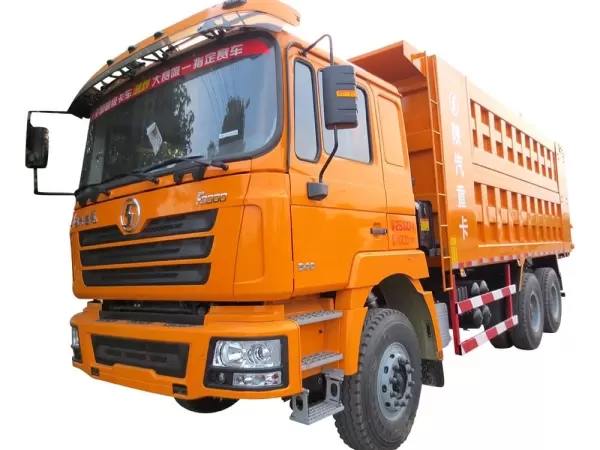 SHACMAN 6x4 35-Ton Heavy Dump Truck for Mining Hauls
Cargo & Dump Truck
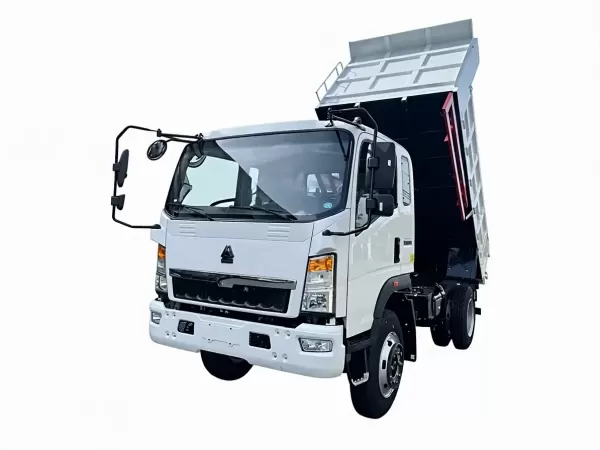 SINOTRUK HOWO 4x2 5-Ton Light Dump for Sand & Gravel
Cargo & Dump Truck
 Dongfeng T3 Bitumen Sprayer Truck for Pavement Preservation
Road Construction Truck
 SHACMAN M3000 Synchronous Chip Sealer for Pavement Care
Road Construction Truck
Tell us your truck model and quantity — an engineer replies within 12 hours with a factory-direct price.
Tell us the model and your requirement — an engineer replies within 12 hours, factory direct.