A tank truck is a specialised body on a commercial chassis, and the body is where both the engineering and the cost sit. The same ISUZU, DONGFENG, SINOTRUK HOWO or SHACMAN carrier can become a diesel bowser, a potable-water tanker or a chemical vessel, and the difference is not cosmetic: the material, the plate thickness, the compartment layout, the pump, the metering and the safety fittings all change with the liquid. Buyers who compare chassis brands before they define the medium usually end up with a vehicle that is either over-specified for water or unsafe for fuel. Factory prices in 2026 run from roughly USD 18,000 for a 10,000 L construction water sprinkler to more than USD 90,000 for a 20,000 L insulated milk tanker or an LPG pressure vessel. This guide covers the tank types, the material choice, the fittings an inspector checks first, the volume-to-payload calculation, the dangerous-goods rules, the price bands, the running costs and the annual inspection routine.
Tank trucks are searched as tanker trucks, tanker lorries or road tankers, but they are specified by what they carry. A fuel tanker needs compartments, vapour recovery, bottom loading and overfill protection. A potable-water tanker needs a food-grade shell, a cleanable interior and a drain at the lowest point. A chemical tanker needs a material that resists the specific acid, alkali or solvent, plus secondary containment where the market requires it. An LPG tanker is a pressure vessel with its own approval route. Write down the medium, its concentration, its temperature and its density before you compare quotations — every one of those answers changes the material, the plate thickness, the fittings and the price.
Two numbers define the duty more precisely than the tank volume: the litres delivered per trip and the number of trips per shift. A depot that delivers 4,000 L of diesel to twelve sites a day needs a different truck from one that moves 20,000 L to a single fuel station, even though both are "fuel tankers". The first needs metering accuracy and a small, manoeuvrable chassis; the second needs volume, a fast pump and a chassis that is legal at full weight on the highway.
Six families cover most orders. The volumes and price bands below are typical factory-direct figures, FOB China, for standard specification in early 2026; the fittings package moves the number more than the chassis badge does.
| Family | Medium | Material and plate | Typical volume | Key fittings | Indicative FOB |
|---|---|---|---|---|---|
| Fuel and oil tanker | Diesel, gasoline, kerosene, jet fuel, lubricants | Carbon steel 4.5–6 mm, epoxy-coated interior where required | 5,000–30,000 L, 2–6 compartments | PTO gear or API pump, totalising meter, vapour recovery, bottom loading, overfill protection, grounding | USD 28,000–65,000 |
| Potable-water tanker | Drinking water | 304 stainless steel or epoxy-lined carbon steel with food-grade fittings | 5,000–20,000 L | Food-grade manhole, cleanable interior, lowest-point drain, sanitary pump | USD 25,000–55,000 |
| Water sprinkler truck | Construction and street water | Carbon steel 4–5 mm, internal anti-corrosion coating | 8,000–20,000 L | Front, side and rear spray bars, water cannon, PTO pump | USD 18,000–38,000 |
| Chemical tanker | Acids, alkalis, solvents | 316L stainless or rubber-lined carbon steel, matched to the medium | 8,000–25,000 L | Safety valve, emergency shut-off, secondary containment, corrosion-resistant pump and seals | USD 55,000–95,000 |
| Milk and edible-oil tanker | Milk, edible oil, beverages | 304 stainless, insulated shell, CIP connections | 10,000–25,000 L | Insulated body, CIP spray balls, sanitary manholes, food-grade pump | USD 60,000–90,000 |
| LPG and gas tanker | LPG, propane, butane | Pressure-vessel steel with approved heads and welding | 5,000–25,000 L | Approved safety valves, pumps, meters, grounding, pressure-class certification | USD 45,000–95,000 |
CLW builds these bodies on tanker truck chassis from ISUZU, DONGFENG, FOTON, SINOTRUK HOWO and SHACMAN. Where a fleet already runs a garbage truck or a road construction truck on the same carrier, keeping one chassis family simplifies driver training and spare-parts stock.
The material is chosen by the medium and by the maintenance regime, not by appearance. Carbon steel is the default for water, diesel and most non-corrosive liquids, and it is the cheapest and easiest to repair. Stainless steel is chosen for potable water, food products and many chemicals; it costs roughly 1.8–2.5 times a carbon-steel shell but needs no internal coating and cleans better. Aluminium is used for fuel and some food products where weight matters, with the caveat that it cannot be used in markets or applications that restrict it and it needs different welding and repair skills. Lined steel — rubber, epoxy or FRP — exists to put a cheap structural shell behind a corrosion barrier, and it is only as good as the lining's adhesion and its repair history.
| Material | Best for | Relative shell cost | Watch out for |
|---|---|---|---|
| Carbon steel, coated | Water, diesel, construction water, general non-corrosive liquids | 1.0 (baseline) | Coating damage during loading; internal corrosion if the coating is breached |
| 304 stainless | Potable water, milk, edible oil, beverages | 1.8–2.5× | Chloride stress corrosion in coastal or chlorinated water; needs correct passivation after welding |
| 316L stainless | Many acids, alkalis and solvents; chloride-bearing media | 2.2–3.0× | Still not universal: confirm against the actual concentration and temperature, not the generic family name |
| Aluminium | Fuel and some food products where payload matters | 1.4–1.8× | Welding and repair skills on site; regulatory restrictions in some markets |
| Rubber-lined steel | Dilute acids, slurries, abrasive media | 1.5–2.0× | Lining adhesion and repair quality; a failed lining is invisible until the shell perforates |
| Pressure-vessel steel | LPG and other liquefied gases | Own approval route | Certification and periodic inspection dominate the cost, not the steel |
Compartment count is the specification buyers most often get wrong. Two to six compartments with individual manholes, ball valves and bottom outlets let one truck deliver several fuel grades, or water plus fuel, on a single route. More compartments mean more fittings, more cleaning and a higher price, so define the delivery pattern first: how many products per trip, and what volume of each. Inside the shell, every compartment needs surge plates welded to reduce liquid movement and keep the load stable during braking and cornering; a compartment with no anti-surge plates puts a moving mass against the baffle welds and the chassis mounts on every stop.
| Fitting | Requirement | What goes wrong when it is missing |
|---|---|---|
| Surge plates | Welded transverse plates dividing the free surface, with openings sized to allow filling and cleaning | Load shifts on braking; welds crack at the shell and the body mounts |
| Manholes | One per compartment, lockable, with a gasket that seals after years of use | Unauthorised access, spillage and vapour release; failed leak test |
| Bottom outlets and valves | One per compartment, with a valve that closes against the full head of liquid | Cross-compartment transfer, spillage on the road, product contamination |
| Vent and overflow | Pressure and vacuum relief sized for the loading rate | Shell deformation during loading or draining; overpressure on a hot day |
| Earthing and bonding | Dedicated earthing point, bonding straps across flexible connections, continuity tested | Static discharge during fuel loading — the classic cause of tanker fires |
| Emergency shut-off | Reachable valve at the delivery point and, where required, at the pump | Uncontrolled discharge in a hose failure or a drive-away |
| Ladder and walkway | Non-slip surface, handrails, and a fall-arrest anchor where the standard requires one | Falls from the top of the shell during dipping and sampling |
Ask for the tank drawing with compartment volumes, surge-plate positions and the fitting schedule before you approve production. These items are easy to specify on paper and expensive to add after the shell is welded, and an inspector will ask for exactly this drawing during the annual inspection.
A tank is bought by volume and licensed by weight, and the gap between the two is the density of the medium. Diesel at 0.84 t/m³, gasoline at 0.74, kerosene at 0.80, milk at 1.03, and sulphuric acid at 1.84 mean the same 15,000 L shell weighs 12.6 t, 11.1 t, 12.0 t, 15.5 t or 27.6 t respectively. Fuel tankers normally operate with an ullage of roughly 5 percent for expansion and are often filled to 90–95 percent of compartment volume in practice, so the payload figure in the specification should be based on the fill you actually use, not the nominal shell volume.
| Shell volume | Water 1.00 t/m³ | Diesel 0.84 t/m³ | Gasoline 0.74 t/m³ | Milk 1.03 t/m³ | 98% sulphuric acid 1.84 t/m³ |
|---|---|---|---|---|---|
| 8,000 L | 8.0 t | 6.7 t | 5.9 t | 8.2 t | 14.7 t |
| 12,000 L | 12.0 t | 10.1 t | 8.9 t | 12.4 t | 22.1 t |
| 15,000 L | 15.0 t | 12.6 t | 11.1 t | 15.5 t | 27.6 t |
| 20,000 L | 20.0 t | 16.8 t | 14.8 t | 20.6 t | 36.8 t |
| 25,000 L | 25.0 t | 21.0 t | 18.5 t | 25.8 t | 46.0 t |
The table explains why a 25,000 L water tanker can be a 6x4 while a 25,000 L acid tanker needs an 8x4 or a smaller shell. Start from the permitted GVW and axle loads, subtract the chassis, the shell, the pump, the fuel and the driver, and the remainder is the payload. Divide that by the medium's density to get the legal shell volume, then subtract the ullage. If the volume the operation needs is larger than the legal one, the answer is more trips or a bigger chassis — not a bigger shell. A tanker filled over its axle limits is a vehicle that fails the weighbridge, wears its tyres unevenly and puts its braking distance beyond the chassis design.
A tank truck carries two regulatory tracks: the vehicle, and the cargo. The vehicle needs the usual homologation, emissions and weight documents for its class. Fuel, chemical and LPG tankers also fall under dangerous-goods transport rules in most markets — ADR in Europe and many export destinations, DOT rules in North America, and national equivalents elsewhere — which govern tank construction, fittings, placards, driver training and route restrictions. Ask which regime applies before production, because a tank built to the wrong regime cannot be placarded, and a vehicle without the right placards cannot legally carry the cargo.
| Market | Vehicle track | Cargo and tank track | Practical note |
|---|---|---|---|
| Saudi Arabia and the Gulf | SASO / SABER (KSA), ESMA (UAE), GSO standards | National dangerous-goods rules; SFDA or MOH registration for potable-water and food tankers | Arabic placards and manuals; food-grade certificate for drinking-water bodies |
| Kenya, Tanzania, Uganda | KEBS PVoC, TBS, UNBS pre-shipment inspection | National dangerous-goods rules; PPB/TMDA/NDA clearance for food contact | Inspection before loading; the tank certificate must name the shipped unit |
| Nigeria and West Africa | SONCAP certificate and pre-shipment inspection | NAFDAC for food and water contact; national fuel-transport rules | Start food-contact registration early; the importer is the applicant |
| Brazil, Mexico and Latin America | INMETRO (Brazil), NOM (Mexico), national homologation elsewhere | National dangerous-goods and food-contact rules; ANVISA or COFEPRIS as applicable | Spanish or Portuguese labels and manuals |
| Russia, CIS and EAEU | EAC conformity, TR CU 018/2011 | EAC plus dangerous-goods certification; cold-climate package | Russian manuals; heated pump cabinet where the winter is severe |
| Right-hand-drive markets | National homologation, often with local inspection | National tank and dangerous-goods inspection | Order RHD at the factory; the pump and valve layout changes with the steering side |
The bands below are factory-direct, FOB China, for a standard build in early 2026. The shell material, the compartment count, the pump and meter brand, the vapour-recovery package and the dangerous-goods certification move the figure — often by more than the chassis choice does.
Compare the same line items: shell material and plate thickness, surge-plate and baffle design, compartment and valve layout, pump brand and flow, meter type and accuracy, vapour-recovery and overfill package, earthing and bonding provision, and the tank drawing delivered before production. A quotation that gives only "fuel tanker 20,000 L, USD 55,000" cannot be compared with another, because the two shells may differ in material, in the number of valves that actually close, and in whether the unit can be placarded at all.
Purchase is about a third of the five-year bill. The table is an illustrative model for a 20,000 L fuel tanker covering 60,000 km a year with 900 pump hours, including annual tank inspection and meter calibration. Your rates will differ; the order of the items rarely does.
| Item | Basis | Five-year total (USD) | Share |
|---|---|---|---|
| Purchase and delivery | USD 55,000 FOB plus freight and duty estimate | 61,000 | 30 % |
| Vehicle fuel | 60,000 km at 30 L/100 km, USD 1.10 | 99,000 | 49 % |
| Tyres | Three sets of six, USD 380 each fitted | 6,800 | 3 % |
| Tank inspection and meter calibration | Annual statutory inspection plus meter calibration | 7,500 | 4 % |
| Pump, valve and hose maintenance | Seals, meters, hoses, valves, PTO service | 8,000 | 4 % |
| Insurance and registration | Dangerous-goods premium, licensing | 9,000 | 4 % |
| Driver and operations | Salary and local overhead, not included here | — | — |
The lesson is not the exact total but the pattern: on a fuel tanker, fuel and the driver dominate, so a chassis that is 10 percent more efficient pays back more than a shell that is 10 percent cheaper. The tank items that protect the licence — inspection, calibration, seals — are small line items that stop the truck entirely if skipped.
Send these twelve answers with the destination port and the dangerous-goods regime that applies, and a builder can return a line-item quotation instead of a range.
| # | Input | What to state | Why it changes the quotation |
|---|---|---|---|
| 1 | Medium | Exact product, concentration, temperature and density | Sets the shell material and lining |
| 2 | Volume and trips | Litres per trip and trips per shift | Sets shell volume and compartment count |
| 3 | Products per trip | How many separate products and the volume of each | Sets compartments, valves and manholes |
| 4 | Pump and meter | Flow in L/min, head, drive type, meter accuracy, nozzle set | Changes the delivery system and the price |
| 5 | Loading method | Top loading, bottom loading or depot gantry | Sets vapour recovery and overfill fittings |
| 6 | Shell material | Carbon steel with coating, 304, 316L, aluminium or lined | The single largest price lever after volume |
| 7 | Chassis and axles | 4x2, 6x4 or 8x4, GVW class and local axle limits | Determines the legal fill volume |
| 8 | Safety package | Earthing, emergency shut-off, extinguisher, placards, certification | Determines whether the unit can operate legally |
| 9 | Route | City distribution, depot shuttle or highway; tunnel and bridge restrictions | Sets chassis size, tank size and route compliance |
| 10 | Driving side and registration | Left- or right-hand drive, port of discharge and approval documents | Changes pump and valve layout and homologation |
| 11 | Delivery | Shipping mode, RoRo or container, and packing requirements | Changes packing, freight and schedule |
| 12 | Service | Spare parts kit, inspection training and warranty terms | Affects price and the uptime you can expect |
CLW builds to MIIT catalogue requirements in an ISO-certified factory. Export files include certificate of origin, commercial invoice, packing list, bill of lading, tank test report and inspection report on request. Standard tank trucks take 25–40 working days after deposit and drawing approval; stainless, lined and LPG builds take 35–55 working days because the welding procedure and the pressure or lining test come before final assembly.
Factory acceptance inspection should include a leak test of the shell and every compartment, a functional test of each valve, a pump flow test against the rated figure, a meter accuracy check and an earthing continuity test. If travel is not possible, ask for video evidence against the drawing and the fitting schedule, and for the leak and test certificates in writing with the delivered serial number. Small units ship in a 40 ft container or on a flat rack; 6x4 and 8x4 tankers normally move by RoRo. More body types are covered in the buying guides.
A tank truck is inspected on two clocks: the chassis follows kilometres, the tank follows calendar and hours. The tank clock is the one that decides whether the vehicle may carry cargo next month.
| Interval | Checks | Parts to keep in stock |
|---|---|---|
| Before every trip | Valve closure, manhole seals, hose condition and couplings, earthing strap continuity, placards, extinguisher pressure, meter totaliser | Gaskets, hose couplings, earthing straps, fuses |
| Weekly | Pump seals and drive, PTO operation, vent and overflow operation, ladder and walkway condition, spill kit complete | Seals, gasket set, spill absorbent |
| Every 10,000 km | Chassis service, brakes, suspension, tyre pressure and wear, body mounts and shell supports | Filters, brake pads, grease |
| Every 6 months | Internal cleaning and coating inspection where accessible, valve overhaul, meter calibration check, hose replacement by age | Valve kits, meter spares, hoses |
| Annually | Statutory tank inspection and leak test, thickness measurement, earthing and bonding test, pressure or vacuum relief test, certification renewal | Certification service, relief valves, gaskets |
Static electricity is the hazard that catches new operators. Bond and earth the vehicle before loading, keep the loading arm or nozzle grounded, do not use plastic funnels or unapproved hoses, and never load into a tank that is being cleaned with a solvent. Fuel vapour plus a spark from an unbonded hose is the classic tanker fire, and the fittings that prevent it are cheap compared with the consequences.
Spill response is part of the specification, not an afterthought: a spill kit on board, absorbent material, a drain seal and a written procedure for a hose failure at the delivery point. For chemical cargoes, add the neutralising agent the medium requires and check that the pump seals are rated for that medium. Finally, respect the load: a tanker with a partially filled compartment has a free surface that moves, so slow down before corners and braking points, and treat a tank with no surge plates as a vehicle that must be driven far more gently than its chassis rating suggests.
Send the medium, concentration, daily volume and destination port through the contact page to receive a configuration with the tank drawing, the fitting schedule, the axle calculation and a line-item quotation. If you are still comparing body types, read the rest of our buying guides first: the same chassis can carry a tank, a tipper or a compactor, and the body specification usually matters more than the badge on the grille.
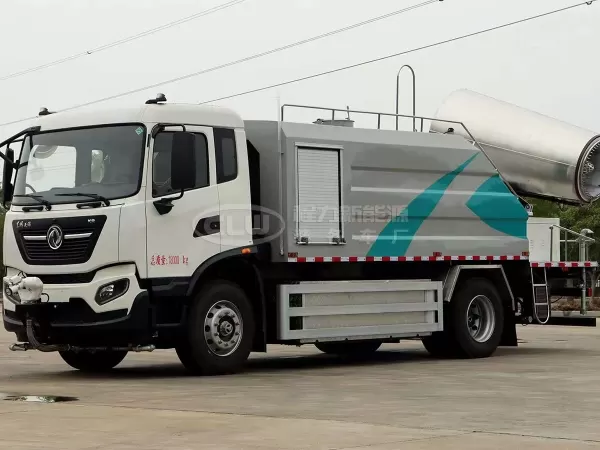 Dongfeng 4X2 Mist Fog Dust Suppression Truck for Dust Control at Yards & Sites
Tanker Truck
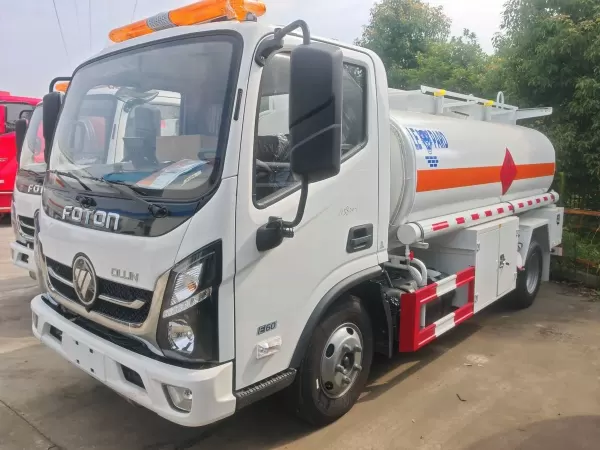 FOTON 4x2 Fuel Tank Truck 5.8CBM Aluminium Petrol Bowser with Flow Meter
Tanker Truck
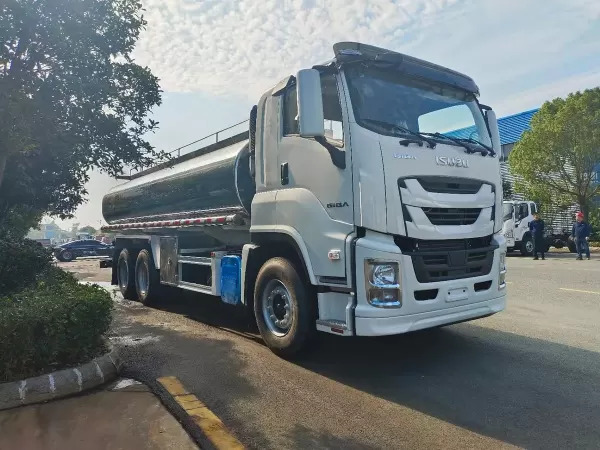 ISUZU GIGA 6x4 Fuel Tank Truck 300HP Aluminium Bowser for Highway Distribution
Tanker Truck
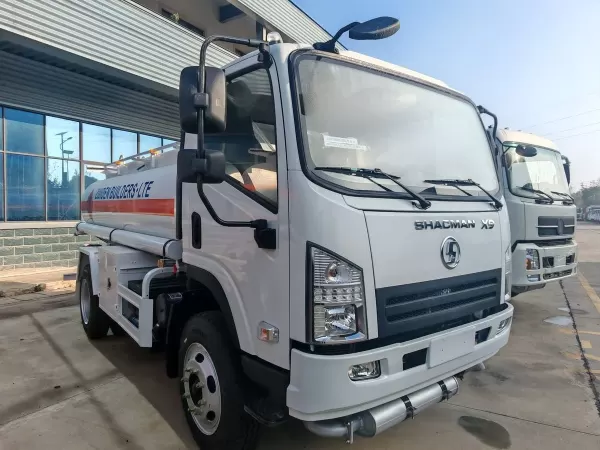 SHACMAN Xuande X9 4x2 Fuel Tank Truck Compact Aluminium Bowser for City Delivery
Tanker Truck
Tell us your truck model and quantity — an engineer replies within 12 hours with a factory-direct price.
Tell us the model and your requirement — an engineer replies within 12 hours, factory direct.