A garbage truck is bought against a collection route, and the route decides almost everything: the bin type, the number of stops per shift, the streets the truck has to fit down, the transfer station it tips at and the density of what it carries. Two trucks with the same body volume can differ by a factor of two in the tonnage they actually move, because household refuse compacts at a different ratio from cardboard, market waste or construction debris. Factory prices in 2026 run from roughly USD 22,000 for a 3-cubic-metre three-wheeled collector for narrow lanes to more than USD 120,000 for a 20 m³ rear loader on an 8x4 chassis. This guide covers the waste streams and their densities, the body families, compaction, bin compatibility, chassis and PTO choices, compliance, price bands, five-year costs, the twelve-point RFQ, maintenance and the safety rules that keep collection crews alive.
Refuse is measured in cubic metres when it is collected and in tonnes when it is tipped, and the two figures are connected by density. Loose household waste arrives at roughly 0.20–0.35 t/m³ and leaves a rear loader at 0.55–0.70 t/m³ after compaction, so a 12 m³ body carries about 7 t of household waste and about 4 t of the same volume in cardboard. Market waste, food waste and construction debris behave differently again: food waste is dense and wet, cardboard resists compaction, and rubble should not be in a compactor body at all.
| Stream | Loose density | Compacted density | Body type | Watch out for |
|---|---|---|---|---|
| Household mixed waste | 0.20–0.35 t/m³ | 0.55–0.70 t/m³ | Rear loader with compactor | Leachate, odour, bin compatibility |
| Cardboard and packaging | 0.05–0.10 t/m³ | 0.15–0.25 t/m³ | Rear loader or open-top skip | Volume-limited, not weight-limited |
| Food and market waste | 0.45–0.60 t/m³ | 0.80–0.95 t/m³ | Sealed rear loader with wash system | Weight limit reached before volume; corrosion |
| Construction and demolition | 0.80–1.20 t/m³ | Not compacted | Hooklift or skip loader, tipper body | Compactor packing plate and body floor damaged |
| Green waste and garden | 0.15–0.30 t/m³ | 0.40–0.55 t/m³ | Rear loader or tipper | Moisture and weight gain |
| Recyclables, sorted | 0.10–0.25 t/m³ | 0.25–0.40 t/m³ | Rear loader with separate compartments | Contamination and glass breakage |
The first question in an enquiry is therefore not "how many cubic metres" but "what stream, at what density, from how many stops, tipped where". A compactor body on a rubble route is a repair bill, and an open skip on a household route means four trips a day where two would do.
| Family | Volume | Loading | Best for | Limits |
|---|---|---|---|---|
| Rear loader with compactor | 6–20 m³ | Crew loads bags and bins at the rear; packing plate compacts | Household collection, mixed waste, the standard municipal truck | Needs a crew of two or three; cycle time per stop |
| Front loader | 12–22 m³ | Forks lift a commercial container over the cab | Commercial and industrial rounds, large bins, one-man operation | Container standard must match the forks exactly |
| Side loader | 8–16 m³ | Mechanical arm lifts wheeled bins from the kerb | One-man residential rounds, wide streets | Arm reach, bin standard, cycle time, street width |
| Hooklift and skip loader | Container 5–20 m³ | Hydraulic hook or chain lifts a container on and off | Construction debris, bulky waste, multi-container fleets | No compaction; container fleet and standard matter |
| Tipper body | 5–15 m³ | Manual or small loader filling; hydraulic tip | Green waste, street sweepings, market cleaning | No compaction; light material fills fast |
| Compact three- or four-wheel collector | 1.5–4 m³ | Manual, rear door, small bin lift | Old towns, lanes, markets, beaches | Narrow chassis, low speed, short range |
Rear loaders remain the default for municipal household collection because the body compacts and the crew can work at a comfortable height. Front and side loaders trade crew size for container standardisation: they only pay off when the bins in the service area are the right standard and in the right place. Hooklift and skip loaders are the flexible option for a depot that serves several waste streams with one chassis, because the container changes and the truck does not.
A compactor body is a hydraulic press with a body around it. The three figures that matter are the packing ratio (compacted volume divided by loose volume, typically 2:1 to 3:1), the cycle time (how long the packing plate takes to complete one stroke, typically 12–25 seconds), and the packing force the structure is designed for. A high packing ratio saves trips; a slow cycle costs stops. On a route with 400 stops the cycle time decides whether the crew finishes before dark.
| Body volume | Packing ratio | Cycle time | Packing force | Practical payload |
|---|---|---|---|---|
| 6–8 m³ | 2:1 to 2.5:1 | 12–16 s | 8–12 t | 3–5 t |
| 10–12 m³ | 2.5:1 to 3:1 | 14–18 s | 12–18 t | 6–8 t |
| 14–16 m³ | 2.5:1 to 3:1 | 16–20 s | 16–22 t | 8–11 t |
| 18–20 m³ | 3:1 | 18–25 s | 20–26 t | 10–14 t |
Structure matters as much as force. The body floor, side walls and the hopper take repeated impact and corrosion from leachate, so the specification should state the steel grade and thickness for the floor and walls, the wear plates at the hopper, the paint system inside and out, and whether the hydraulic cylinders are protected from the load. A compactor body built to a low steel specification loses its floor in three years on a food-waste route.
Bins are not universal. A rear loader with a bin lift designed for 240-litre wheeled bins cannot empty a 1,100-litre container, and a front loader's forks only fit the container standard they were built for. Before ordering, measure the bins actually in service: type (wheeled, round, container, skip), volume, and the lifting points or trunnions. Specify a bin lift that handles the range, and state whether the crew will also collect bags by hand. A truck that arrives with the wrong lift is a truck that starts its life with an unplanned modification.
For a fleet serving several districts, the same logic applies to the container standard for hooklift bodies: a hooklift truck with a 5 t hook cannot handle a 12 m³ container built for an 8 t hook, and the depot ends up with containers that only one chassis can move.
Collection duty is stop-start with a power take-off running the hydraulics for most of the shift, which is harder on the chassis than highway work suggests. The chassis needs a rear axle and springs rated for the loaded body, a PTO and hydraulic pump sized for the compactor's flow and pressure, a cooling package that survives low-speed operation in summer, and a body subframe that spreads the load into the frame rather than into six bolts.
| Body | Chassis | GVW | PTO and pump | Note |
|---|---|---|---|---|
| 6–8 m³ rear loader | 4x2, wheelbase 3.3–3.8 m | 7.5–10 t | PTO with 40–60 L/min pump | Narrow streets; check turning circle |
| 10–12 m³ rear loader | 4x2 or 6x2, wheelbase 3.8–4.5 m | 12–16 t | 60–80 L/min, oil cooler | Most municipal rounds |
| 14–16 m³ rear loader | 6x4, wheelbase 4.5–5.2 m | 18–25 t | 80–100 L/min, oil cooler | Weight limit reached before volume on food waste |
| 18–20 m³ rear loader | 8x4, wheelbase 5.0–5.8 m | 25–31 t | 100–120 L/min, oil cooler | Transfer-station shuttle; check bridge limits |
| Hooklift 12–20 m³ container | 6x4 or 8x4 | 18–31 t | PTO with high-flow pump for the hook | Container fleet and hook rating must match |
Hydraulic oil temperature is the most common mechanical failure on a collection round: the pump runs at every stop, the truck barely moves, and without an oil cooler the fluid thins, the cycle slows and the seals go. Specify the cooler and the tank size, and check that the pump flow matches the compactor valve block rather than only the cylinder size.
Buyers who ask "how many wheels" usually mean two different things: the drive configuration on the badge (4x2, 6x2, 6x4, 8x4) and the number of tyres actually touching the road. They are related but not identical, because a 6x2 can run single or dual rear tyres and an 8x4 usually runs dual rear axles with single front tyres.
| Configuration | Tyres | GVW class | Body it suits | Where it does not work |
|---|---|---|---|---|
| 4x2 | 6 (2 front, 4 rear in dual) | 7.5-12 t | 6-8 m³ rear loader; narrow lanes and old town centres | Payload runs out on dense food waste; short wheelbase limits the body |
| 6x2 with tag axle | 8-10 | 16-20 t | 10-12 m³ rear loader on mixed routes | The tag axle must lift or the turning circle suffers; axle load rules vary |
| 6x4 | 10 (2 front, 8 rear) | 18-25 t | 14-16 m³ rear loader, hooklift | The longer chassis loses access in narrow streets |
| 8x4 | 12 | 25-31 t | 18-20 m³ rear loader, transfer shuttle | Bridge limits and route width; tyres and brakes cost more |
Pick the configuration backwards from the legal axle load in the destination market, not from the badge. More wheels spread the same gross weight over more contact patches, which matters on soft ground, but they also add tare, tyre cost and turning radius. A short 4x2 that fits the street and comes back twice is often cheaper over five years than an 8x4 that cannot reach half the stops.
Body volume is geometry; capacity is what the weighbridge allows. Volume multiplied by compacted density gives the weight the body would hold if it were filled, but the practical payload of the chassis underneath is usually the smaller number - and on dense waste it stops the trip with the body still part-empty. A 14-16 m³ body filled with food waste would weigh about 14.4 t; the 6x4 chassis beneath it carries 8-11 t, so the truck leaves with the body roughly two thirds full. On cardboard the same body holds 3.2 t, a quarter of what it can legally carry.
| Body volume | Household waste, 0.6 t/m³ | Food waste, 0.9 t/m³ | Cardboard, 0.2 t/m³ | Practical payload of the chassis | What stops the trip |
|---|---|---|---|---|---|
| 6-8 m³ | about 4.8 t | about 7.2 t | about 1.6 t | 3-5 t | Payload on food waste, below 6 m³; volume on cardboard |
| 10-12 m³ | about 7.2 t | about 10.8 t | about 2.4 t | 6-8 t | Payload on food waste at about half body; volume on paper |
| 14-16 m³ | about 9.6 t | about 14.4 t | about 3.2 t | 8-11 t | Payload two thirds up on food waste; volume on cardboard |
| 18-20 m³ | about 12 t | about 18 t | about 4 t | 10-14 t | Payload, unless the stream is packaging |
The practical capacity of a 16 m³ body is therefore not 16 m³ of anything: it is about 10 t of household waste, 8-11 t of food waste at the axle limit, and 3 t of cardboard that still leaves the body two thirds empty. That last case is why paper and packaging rounds use open-top or hooklift bodies with much larger volume and no compactor, and why the same 16 m³ rear loader is the wrong truck for a recycling depot.
Collection duty spends most of its hours at walking pace with the power take-off driving the hydraulics, so low-speed torque and cooling matter more than top speed. An engine one size too small for a full 20 m³ compactor will run hot and slow all shift, while a large engine on a narrow-street round burns fuel it never uses. Size the engine to the body and the terrain, not to the number on the badge.
| Chassis class | Engine | Power | Low-speed torque | Route fuel use |
|---|---|---|---|---|
| 4x2 light, 7.5-10 t | 2.8-3.8 L diesel | 90-130 hp | 280-380 Nm | 18-24 L/100 km |
| 4x2 or 6x2, 12-16 t | 4.5-6.0 L diesel | 160-220 hp | 550-800 Nm | 25-33 L/100 km |
| 6x4, 18-25 t | 6.8-8.0 L diesel | 240-300 hp | 900-1,200 Nm | 32-40 L/100 km |
| 8x4, 25-31 t | 8.8-9.7 L diesel | 300-340 hp | 1,100-1,400 Nm | 40-50 L/100 km |
The PTO is the part buyers forget. It is driven from the gearbox or the engine front, it must engage at low engine speed without shock, and its flow has to match the valve block and the hydraulic pump, not only the cylinder bore. Check the cooling package for the real duty: a full compactor cycle every 40 seconds at 15 km/h produces more heat than the same engine produces on a highway at 80 km/h. Where a city has a low-emission zone or a night noise limit, an electric or hybrid 4x2 collector removes the idle noise and the exhaust at the stop, at a purchase price premium.
A collection crew spends its shift outside the cab, and the design details that protect them are cheap at the factory and expensive to retrofit. Specify steps with a non-slip surface at the right height, handholds at each door and at the hopper, a low loading height at the rear, a wash-down system with a water tank and a hose reel, sealed body joints so leachate does not reach the chassis, and a reversing camera and alarm that the crew actually hears. Odour control — sealed tailgate, drainable body floor, a wash cycle at the depot — is a specification item, not an afterthought.
For hot climates, add a cab air-conditioning specification with the compressor sized for the duty and a body paint system resistant to UV. For cold climates, specify heated hydraulic oil or an oil that stays workable at the winter minimum, and check that the PTO engages reliably when the engine is cold.
A garbage truck is approved as a vehicle and accepted by a municipality, and the two sets of requirements are different. The vehicle needs homologation, emissions certification and weight approval for the destination market. The municipality or the waste authority usually adds its own requirements: body colour and livery, registration plates and reflective markings, noise limits for night collection, wash-down facilities, GPS or route tracking, and sometimes a weighbridge interface for tonnage reporting.
| Market | Vehicle track | Municipal or waste-authority track | Practical note |
|---|---|---|---|
| Saudi Arabia and the Gulf | SASO / SABER (KSA), ESMA (UAE), GSO standards | Municipality livery, night-noise limits, wash-down requirement | Arabic labels; high-ambient cooling package |
| Kenya, Tanzania, Uganda | KEBS PVoC, TBS, UNBS pre-shipment inspection | County or city-council fleet standards; weighbridge reporting | Inspection before loading; spare parts kit is essential |
| Nigeria and West Africa | SONCAP and pre-shipment inspection | State waste agency livery and route requirements | Robust hydraulic specification for poor roads |
| Brazil, Mexico and Latin America | INMETRO (Brazil), NOM (Mexico), national homologation | Municipal noise and livery rules | Spanish or Portuguese manuals and labels |
| Russia, CIS and EAEU | EAC conformity, TR CU 018/2011 | Municipal contracts specify body volume and tipping point | Cold-climate hydraulics and cab heater |
| Right-hand-drive markets | National homologation and inspection | Council fleet standards and bin standards | Order RHD at the factory; crew access changes with the side |
Ask for the emissions standard in writing on the quotation. Euro III and Euro V chassis are both still available for export, and a city that has adopted a low-emission zone will refuse a truck that does not meet its standard, whatever the body specification says.
Compare line items: body steel thickness and wear plates, paint system, packing ratio and cycle time, bin lift type and range, hydraulic pump flow and oil cooler, wash system, container standard for hooklifts, emissions standard and livery. A quotation that says only "12 m³ garbage truck, USD 55,000" does not state whether the body floor is 4 mm or 6 mm steel, whether there is an oil cooler, or whether the bin lift fits the bins the city already owns.
An illustrative model for a 12 m³ rear loader on a 6x2 chassis covering 30,000 km a year on a collection round with about 2,000 hours of PTO operation. Your fuel price, labour cost and route profile will differ; the proportions are what matter.
| Item | Basis | Five-year total (USD) | Share |
|---|---|---|---|
| Purchase and delivery | USD 58,000 FOB plus freight and duty estimate | 66,000 | 30 % |
| Fuel | 30,000 km at 35 L/100 km plus PTO hours, USD 1.10/L | 88,000 | 40 % |
| Hydraulic service | Oil, filters, hoses, cylinder seals, pump overhaul | 12,000 | 5 % |
| Body repair | Floor and hopper wear plates, tailgate seals, paint, bin lift | 14,000 | 6 % |
| Chassis service and tyres | Scheduled service, two tyre sets, brakes, springs | 18,000 | 8 % |
| Insurance and registration | Vehicle and municipal permits | 9,000 | 4 % |
| Crew labour | Two crew plus driver, not included here | — | — |
On collection duty, fuel and body repairs together outweigh everything else, and both are affected by the cycle time and by how the crew drives the packing cycle. A body with a fast cycle and a good oil cooler costs less to run than a cheaper body that runs hot: the hydraulic bill arrives every year, and the fuel bill arrives every shift.
| # | Input | What to state | Why it changes the quotation |
|---|---|---|---|
| 1 | Waste stream | Household, food, cardboard, construction, green waste, recyclables | Sets body family and compaction |
| 2 | Density and tonnage | Tonnes per trip and per shift | Sets body volume and payload |
| 3 | Stops per shift | Number of stops and distance between them | Sets cycle time requirement and crew size |
| 4 | Bins | Bin type, volume, lifting points, number in service | Sets the bin lift or forks |
| 5 | Streets | Width, turning radius, overhead limits, gradients | Sets chassis length and wheelbase |
| 6 | Disposal point | Transfer station, landfill, tipping height and access | Sets body volume and tipping geometry |
| 7 | Body volume | m³ and the compaction ratio expected | Sets steel specification and packing force |
| 8 | Crew | One, two or three crew; loader side | Sets side or rear loading and cab layout |
| 9 | Wash and odour | Wash-down requirement, depot facilities, night collection | Adds water tank, hose reel and sealed body |
| 10 | Tracking | GPS, route reporting, weighbridge interface | Adds electronics and integration work |
| 11 | Livery and approval | Municipal colour, reflective markings, emissions standard, RHD or LHD | Adds paint, marking and homologation work |
| 12 | Service | Spare parts kit, crew training, warranty and response time | Affects price and uptime |
CLW builds garbage bodies on ISUZU, DONGFENG, SINOTRUK HOWO and SHACMAN chassis in an ISO-certified factory. Standard rear loaders up to 12 m³ take 25–40 working days after deposit and drawing approval; 14–20 m³ bodies and hooklifts take 40–60 working days; municipal livery and electronics add one to two weeks. Hydraulic components ship with test reports and the body drawing set travels with the truck.
Factory acceptance should include a full packing cycle with the body empty and loaded, a bin-lift test with the actual bin size, a tipping test at the specified tipping point, and a hydraulic pressure and temperature record after an hour of simulated collection. If you cannot attend, ask for video of the packing cycle and the bin lift. Garbage trucks normally ship by RoRo; small three-wheel collectors ship in containers or on a flat rack. More body types are covered in the buying guides, including the garbage truck range itself and the tanker trucks that many fleets run alongside.
| Interval | Checks | Parts to keep in stock |
|---|---|---|
| Before every shift | Hydraulic oil level and leaks, tailgate seal, bin lift, packing plate travel, hopper for obstructions, wash tank, warning lamps and reversing alarm | Hoses, seals, lamps, fuses |
| Every 250 hours | Oil cooler and radiator cleaning, hydraulic filter, cylinder rod condition, PTO engagement, bin lift pins and rollers, body floor and hopper wear plates | Filter set, hydraulic oil, wear plates, pins |
| Every 10,000 km | Chassis service, brakes, springs, tyres, subframe bolts, body mountings | Filters, brake pads, grease |
| Annually | Hydraulic system pressure test, cylinder seal inspection, body structure and floor thickness check, paint repair, emissions test | Seal kit, paint, test service |
| After any impact | Tailgate alignment, hopper and floor deformation check, hydraulic line inspection before the truck returns to route | Seals, hoses, floor plates |
Collection is one of the more dangerous municipal jobs, and most incidents happen at the hopper. The crew must never stand in the hopper or reach into it while the packing plate is moving, and the emergency stop must be within reach of the person loading, not only in the cab. Specify an interlocked hopper guard where the market allows it, visible reversing lights and an audible alarm, a camera that the driver actually uses, and steps and handholds designed for people who are tired and wearing gloves.
Two hazards are specific to this body type. The first is the packing plate: it is powerful, quiet and fast, and it does not stop because someone shouted. The second is the load itself: pressurised containers, aerosols, batteries and sharp objects in household waste cause injuries and fires. Train the crew to reject visibly hazardous items, keep a fire extinguisher accessible at the hopper, and never let anyone ride on the step or the rear platform between stops. Leachate is also a hazard: it is corrosive, it smells, and it makes steps and the ground around the truck slippery — wash and drain the body at the depot, not on the route.
Send the waste stream and its density, the tonnes per shift, the number of stops, the bin types in service, the street constraints and the disposal point through the contact page to receive a chassis and body configuration with the packing ratio, bin lift, hydraulic specification and a line-item quotation. If you are still comparing body types, read the rest of our buying guides first: a garbage truck, a tipper and a hooklift are bought for different routes, and the body is where the money is spent.
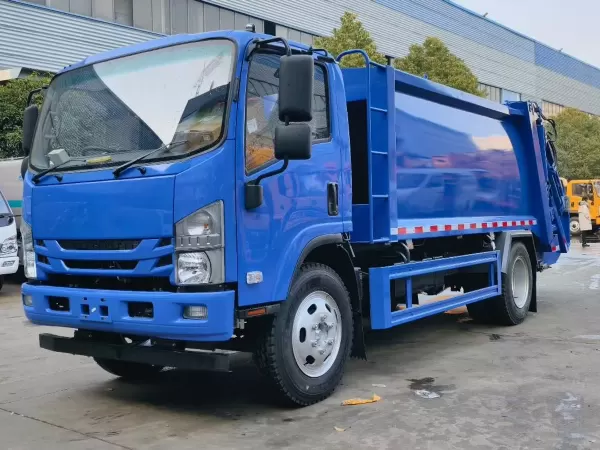 ISUZU ELF 4x2 8m3 Compactor Garbage Truck Light Rear Loader
Garbage Truck
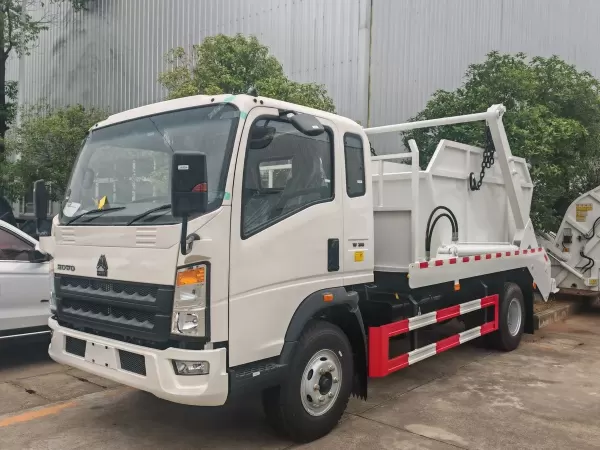 SINOTRUK 4x2 Light Skip Loader Garbage Truck 4m3 Swing-Arm
Garbage Truck
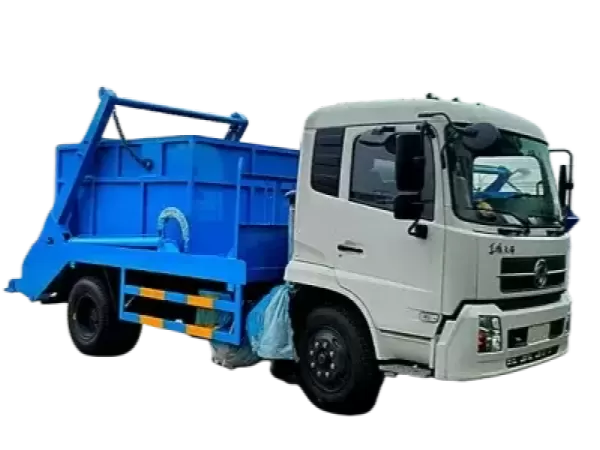 Dongfeng 10cbm Swing-Arm Bin Lift Garbage Truck
Garbage Truck
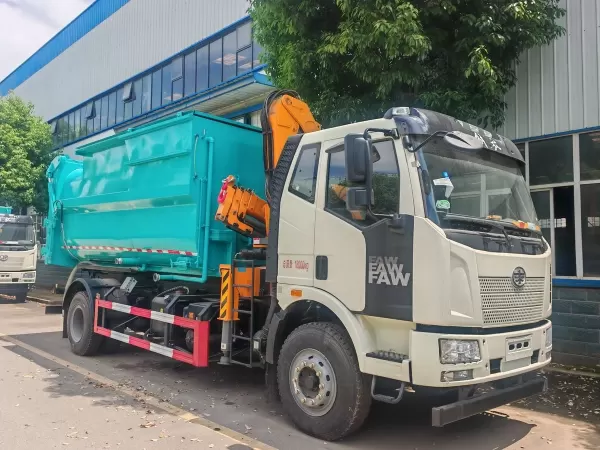 FAW 4x2 Refuse Transfer Truck with Knuckle Boom Crane and Sealed Compression Container
Garbage Truck
Tell us your truck model and quantity — an engineer replies within 12 hours with a factory-direct price.
Tell us the model and your requirement — an engineer replies within 12 hours, factory direct.