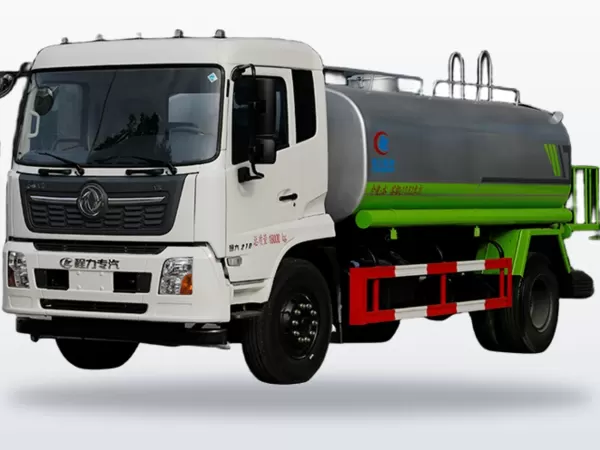
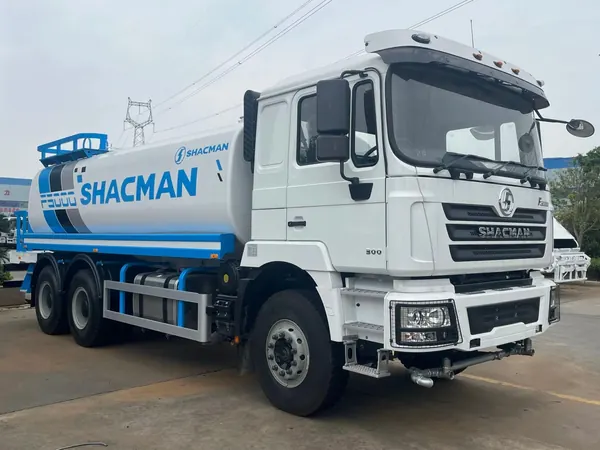
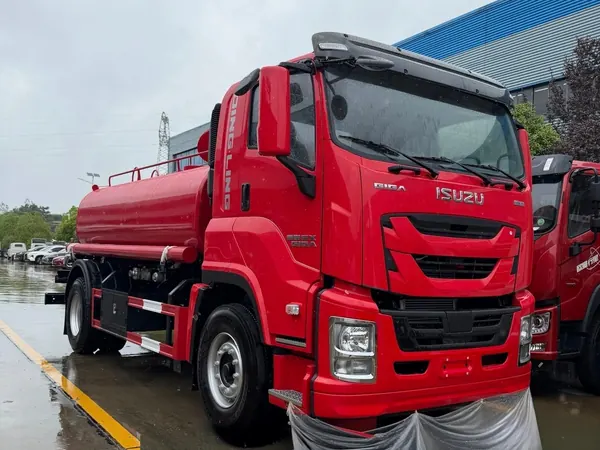
For sale · factory direct
A water tanker does one of three jobs: it sprays to control dust and wash roads, it delivers bulk water where there is no main, or it carries drinking water in a stainless, food-grade tank. The body, the pump and the tank material follow from that choice — and so does the price.
Every figure on this page is a budget framework for factory-direct FOB China, not a quotation. Chassis brand, tank material, pump type, spray equipment, emission standard and freight all move the final number.
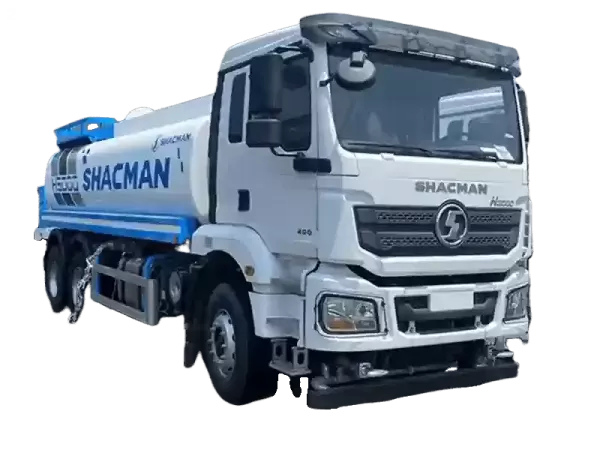
Standard specifications, carbon steel tank, left-hand drive, China FOB. Figures are a budget framework, not a quotation.
| Configuration | Tank volume | Typical budget (USD, FOB) | Fits |
|---|---|---|---|
| 4x2 water tanker | 5–8 m³ (5,000–8,000 L) | 22,000 – 32,000 | Estate roads, small towns, site dust control |
| 6x2 or 4x2 mid-volume tanker | 10–15 m³ | Quoted per configuration | City road washing, parks, construction supply |
| 6x4 water tanker | 25–30 m³ (25,000–30,000 L) | 55,000 – 80,000 | Municipal road washing, bulk supply, dust suppression |
| Stainless potable water tank | Same as base tank | Quoted per specification | Drinking water, food-grade transport |
The mid-volume row sits between the two published bands because chassis, tank and pump change together at that size. It is quoted against a written duty — litres needed, trips per day, spray width — rather than from a price list.
The three uses look alike on a specification sheet and behave very differently on the road.
| Use | Body and fittings | Pump duty | Watch out for |
|---|---|---|---|
| Road washing and dust control | Spray bar front and rear, side nozzles, rear cannon, hose reel | Self-priming pump sized for simultaneous spray and cannon | Spray pressure drops when the cannon and bar run together |
| Bulk water supply | Large manhole, fast discharge valve, no spray bar | High-flow transfer pump | Discharge time, not tank size, limits trips per day |
| Drinking water | Stainless tank, food-grade coating, sealed manhole, sampling point | Food-grade pump and hose | Any non-food-grade fitting defeats the whole tank |
| Construction and concrete plant | Simple tank, hose connections, no spray bar | Pump sized to the mixing point | Dust and grit enter the tank; plan for cleaning |
A truck ordered for road washing is not a drinking-water truck with a different paint scheme. Materials and fittings are different, and the difference is not visible from the outside.
Capacity is decided by the route, not by the biggest tank that fits the chassis.
For washing and dust control, estimate the area one load can cover: tank volume divided by the application rate. A 10,000 L tank applying roughly one litre per square metre covers about 10,000 m², or a strip about 3.5 m wide and 2.8 km long. Halve the rate and the same tank covers twice the distance — which is why the spray system matters as much as the tank.
For bulk supply, work backwards from the delivery point: how many litres per day, how fast can the site unload, and how long is the round trip. A larger tank that waits an hour at every discharge point is a worse investment than two smaller trucks.
For drinking water, the volume follows the population served and the refill interval, and the tank material is fixed by regulation rather than by budget.
Whatever the duty, check the weights. Water is one kilogram per litre: a full 30,000 L tank adds thirty tonnes, and the chassis, axle ratings and tyres have to be chosen for that load from the start.
Shape, baffles and coating decide stability on the road and the life of the tank.
A lower centre of gravity than a round tank of the same volume, which matters on a part-full truck. Most municipal sprinkler bodies use this shape.
Baffles divide the tank into compartments so the water does not surge when braking or turning. On a 20,000 L tank, an unbaffled load is a handling problem on every bend and a structural load on the ends.
Carbon steel with a proper internal coating suits washing and construction water. Stainless steel, or a food-grade coating system, is required for drinking water. Salt water and chemical loads need their own specification.
Ask what the inside of the tank is coated with, and for the potable supply chain of that coating. The outside paint is the part nobody needs to worry about in ten years.
The pump turns the chassis engine into water pressure; the spray fittings decide how that pressure is used.
A self-priming centrifugal pump driven from the gearbox PTO is the standard arrangement. Flow and head have to be matched to the spray bar, the cannon and the hose reel, and to whether they run together. A pump specified only for the spray bar will disappoint the operator the first time the cannon is opened.
Spray bars are usually fitted front and rear, with side nozzles for kerb washing and a rear cannon for dust suppression and watering. Hose reels serve hand watering and wash-down. Each outlet needs its own valve, and the piping has to be laid out so that opening one outlet does not starve another.
On potable water trucks, every wetted part — pump, valves, hoses, couplings — must be food-grade. This is where a low quotation usually gives itself away.
Ask every supplier for the same line items, then compare column by column.
A quotation that leaves a line out is not cheaper. Ask for the missing item in writing and compare again.
Water tankers are built to MIIT catalog requirements in an ISO-certified factory. Each tank is leak-tested before shipment, the pump is run against a closed valve, and the spray system is checked through its full range of outlets. Test records are supplied with the shipping documents on request.
Lead time is typically 20–30 working days for a standard 4x2 sprinkler after drawing approval and deposit, and 30–45 working days for 6x4 units, stainless tanks or potable water packages. Chassis availability and the emission package are the two items most likely to extend that window.
Export files include certificate of origin, commercial invoice, packing list and bill of lading, with inspection or test records on request. Loading photos, lifting points and blocking instructions are supplied before departure. Right-hand drive and local homologation packages are prepared per order where the destination market requires them.
For tank capacities, pump selection and the difference between sprinkler and bulk supply bodies in more depth, read the water tanker truck buying guide; the full range is on the tanker truck page.
Start from the area to be washed per shift and the application rate. At roughly one litre per square metre, a 10,000 L load covers about 10,000 m² — a strip around 3.5 m wide and 2.8 km long. Tell us the route length, spray width and how many passes per shift, and the tank size follows.
Not safely. Potable service requires a stainless tank or a certified food-grade coating, food-grade pump, valves and hoses, and a sealed manhole. A tank used for construction water cannot be converted by cleaning alone. If both duties exist, specify two tanks or one dedicated potable unit.
The tank may be identical; the difference is the equipment around it. A sprinkler truck carries spray bars, side nozzles, a rear cannon and a hose reel with a pump sized for them. A water tanker for bulk supply is built around a fast discharge valve and a high-flow transfer pump.
Usually from a gearbox PTO with a self-priming centrifugal pump. The PTO ratio and pump speed are matched so the rated flow is reached at normal engine speed. Ask for the flow and head at the working engine speed, not only the pump's maximum figures.
Right-hand drive, Euro 3 to Euro 6 engines and market-specific cooling packages are configured per order, subject to chassis availability in that specification. Tell us the destination country at the enquiry stage, because the emission standard and homologation package have to be decided before the chassis is ordered.
Send the litres needed, the duty (spray, bulk supply or potable), the route or delivery pattern, chassis preference and destination port. You get a specification sheet and a budget band for that exact configuration, usually within one working day, with no obligation.
Tell us your truck model and quantity — an engineer replies within 12 hours with a factory-direct price.
Tell us the model and your requirement — an engineer replies within 12 hours, factory direct.