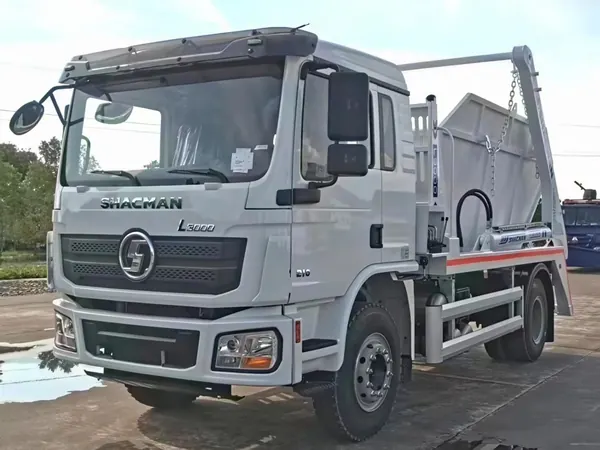
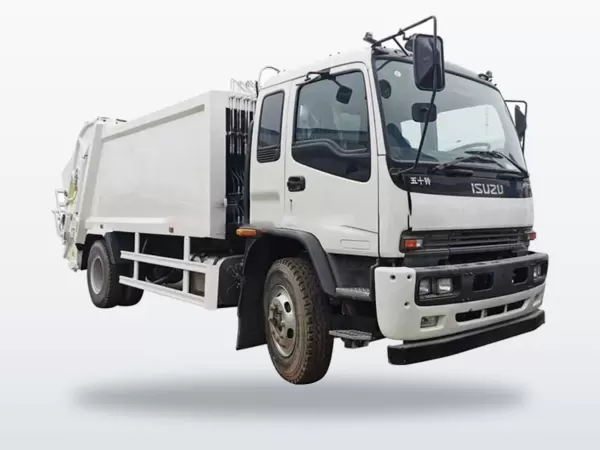
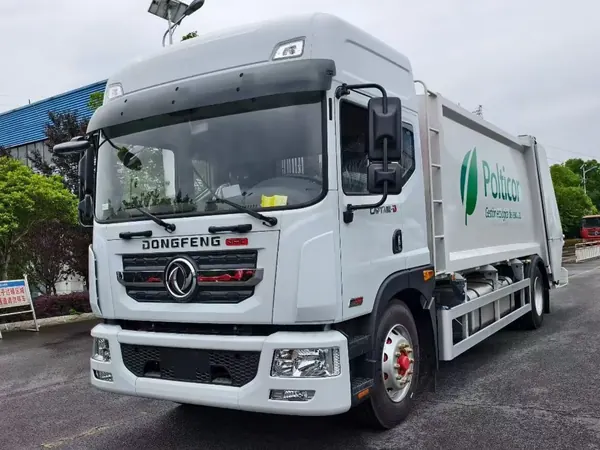
For sale · factory direct
A compactor body is a hydraulic press on wheels. It packs refuse at the kerb, so a 10 m³ body carries what an open truck of more than twice that volume would. Which body you choose — rear loader, side loader or hooklift — shapes the price as much as the chassis underneath it.
Every figure on this page is a budget framework for factory-direct FOB China, not a quotation. Chassis brand, plate thickness, bin-lift type, emission standard, steering side and freight all move the final number.
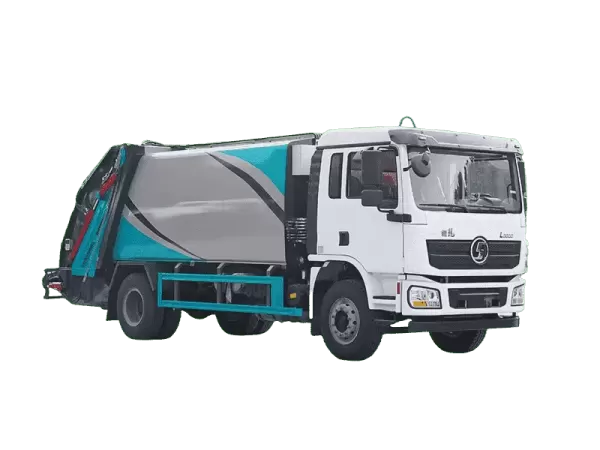
Standard specifications, carbon steel body, left-hand drive, China FOB. Figures are a budget framework, not a quotation.
| Body type | Body volume | Typical budget (USD, FOB) | Fits |
|---|---|---|---|
| 4x2 rear-loader compactor | 5–8 m³ | 28,000 – 40,000 | Narrow residential lanes, manual loading |
| 6x4 rear-loader compactor with bin lift | 10–12 m³ | 45,000 – 65,000 | City routes with 120 L and 240 L wheelie bins |
| Side-loader body | 8–10 m³ | 42,000 – 60,000 | One-person kerbside collection |
| Hooklift or skip loader with one open body | 8–20 m³ | 30,000 – 45,000 | Construction debris and container exchange |
| Stainless or food-waste body | Same as base body | Add 15–25% | Wet, corrosive or organic waste |
The bands are wide on purpose. The same 10 m³ body ships at two very different prices depending on the chassis underneath and the hydraulic package on top. Narrowing a band is a five-line specification job, not a negotiation.
Three movements explain both the payload advantage and most of the maintenance cost.
Refuse drops into the hopper and a packer panel sweeps it into the body. The panel returns, the next load drops in, and the cycle repeats. Cycle time and panel travel decide how fast a crew can work a route — not the top speed of the truck.
Packing squeezes air and voids out of mixed municipal waste, so the effective payload of a 10 m³ body is several times its geometric volume. Ratios depend on waste mix, moisture and packer force; food-heavy waste packs less than dry commercial waste.
At the tipping point an ejector panel pushes the whole load out. A slow or sticking eject costs crew hours every shift, which is why cylinder size, guide rails and wear plates matter more than the headline compaction force.
A body that packs well but ejects badly is a body that loses money. Ask for the eject cycle time in writing, not just the compaction ratio.
Pick the loading method from the crew and the street, then price it — not the other way round.
| Route and crew | Body | Why it wins | Watch out for |
|---|---|---|---|
| Narrow lanes, manual bags and small bins, three-person crew | 4x2 rear loader | Short wheelbase and a low loading sill; the crew works behind the truck | Manual handling injuries are the main operating cost |
| Standard wheelie bins, dense streets, two- or three-person crew | 6x4 rear loader with bin lift | Lift handles 120 L and 240 L bins; higher payload per trip | Lift rating and interlock are safety items — verify them |
| Wide avenues, single operator, kerbside bins | Side loader | Driver loads from the cab side without leaving the seat | Only pays off where bins are standardised and spaced |
| Construction, bulky waste, transfer stations | Hooklift / skip loader | One chassis serves several containers; no compaction of rubble | Not a compactor: volume per trip is lower, but exchange is fast |
If a route mixes narrow lanes with a transfer station, price two smaller trucks against one large truck before deciding. The body is usually the cheaper half of that argument.
Ask every supplier for the same line items, then compare column by column.
A quotation that leaves a line out is not cheaper. Ask for the missing item in writing and compare again.
A simple check before you choose a volume: how many trips does the route need per shift?
Start with the waste collected per shift, divide by the body volume, then divide again by the compaction ratio you expect for that waste mix. If the answer is more than two trips to the tipping point, the body is too small or the route is too long — and a larger body is usually cheaper than a second truck and crew.
Municipal contracts often fix the collection frequency and the bin type, which narrows the choice quickly: 240 L bins on a dense route point to a rear loader with a comb lift; scattered 120 L bins on wide streets point to a side loader; construction and bulky waste point to a hooklift, where compaction is irrelevant.
Volume, body type and chassis must be decided together. A 20 m³ body on a light 4x2 chassis is a specification that will not pass a weight check once it is loaded.
Compactor trucks are built to MIIT catalog requirements in an ISO-certified factory. Before shipment the body is tested through pack, eject and bin-lift cycles, and the test record is supplied with the shipping documents on request.
Lead time is typically 25–35 working days for a standard rear loader after drawing approval and deposit, and 30–45 working days for stainless, side-loader or multi-function bodies. Chassis availability and the emission package are the two items most likely to extend that window.
Export files include certificate of origin, commercial invoice, packing list and bill of lading, with inspection or test records on request. Lifting points, blocking instructions and loading photos are supplied before departure. Right-hand drive and local homologation packages are prepared per order where the destination market requires them.
For compaction ratios, bin systems and body construction in more depth, read the garbage truck buying guide; if cost is the open question, the garbage truck price guide covers budget bands by body type.
Yes, for mixed municipal waste. Compaction removes air and voids, so the effective payload of a 10 m³ compactor body is several times its geometric volume, depending on the waste mix. For rubble and construction waste the advantage largely disappears, which is why hooklifts are used there instead.
Follow the bins. Standardised 120 L and 240 L wheelie bins on dense streets favour a 6x4 rear loader with a comb lift; wide avenues where the driver can serve kerbside bins alone favour a side loader. If the crew loads by hand from bags, a 4x2 rear loader with a low sill is the practical choice.
Yes, where a suitable chassis is available locally and local mounting is permitted. The price then covers the body, hydraulic kit and bin lift, and shipping volume drops sharply — often the larger saving. Send the chassis model, wheelbase and PTO specification so the subframe can be matched.
Hydraulic oil and filter changes on a fixed interval, inspection of hoses and cylinders, and checking the packer panel and ejector guide rails for wear. Seal kits, wear plates and filters are supplied with the truck, and repeat orders are quoted against the body serial number.
Right-hand drive, Euro 3 to Euro 6 engines and market-specific cooling packages are configured per order, subject to chassis availability in that specification. Tell us the destination country at the enquiry stage, because the emission standard and homologation package have to be decided before the chassis is ordered.
Send the bin type, body volume, chassis preference, crew size and destination port. You get a specification sheet and a budget band for that exact configuration, usually within one working day, with no obligation.
Tell us your truck model and quantity — an engineer replies within 12 hours with a factory-direct price.
Tell us the model and your requirement — an engineer replies within 12 hours, factory direct.