An 18-tonne electric garbage truck came back to the depot with 160 km on the trip meter. The registration filing promised 280 km. The battery pack was healthy. The problem was the 3.8-tonne steel body bolted on top of it. This is the engineering record of taking 300 kg out of that body — and finding 42 km of range in the process.
Range anxiety in electric refuse truck fleets is usually framed as a battery question. In practice, it is often a body question. Municipal collection is a stop-start duty cycle: the truck accelerates, brakes, compacts, waits, and pulls away again hundreds of times a day. Every kilogram of body structure is carried through every one of those cycles, and on a compressed natural gas or diesel chassis the penalty is absorbed by a fuel tank. On a battery-electric chassis, it is paid directly out of range.
During a recent fleet study, we followed an 18-tonne electric compression garbage truck on its normal municipal route. With a full charge and a full load, the truck consistently delivered about 160 km — well short of the 280 km quoted in its homologation filing. The route required one complete collection round per day. To finish it, the crew had to return to the depot at midday and recharge, which ruled out a second working shift and cut the truck's effective duty cycle.
Telematics data and driver feedback pointed to the same conclusion. The body weighed 3,800 kg — roughly 200 kg more than the body fitted to the equivalent diesel truck. That excess was not payload, not safety equipment, and not a customer option. It was structural and material redundancy inherited from a design process built around manual welding and uniform steel plate. We set a target of 300 kg and attacked it on three fronts: material selection, structural layout, and manufacturing process.
The result, measured on the same route with the same load: range rose from 160 km to 202 km, the midday recharge disappeared, and the crew gained an extra collection trip per day. Below is the full teardown — what we changed, how we calculated it, and how we proved that the lighter body is still strong enough.
Lightweighting is not a competition to remove the most kilograms. Three numbers have to move together: kilograms removed, energy consumption reduced, and range gained. If the third number cannot be measured, the first two are only an assumption. Before cutting any steel, we ran the truck at three body weights and recorded full-load consumption on the same duty cycle.
| Body weight | Full-load consumption |
|---|---|
| 3,800 kg | 118 kWh/100 km |
| 3,500 kg | 112 kWh/100 km |
| 3,400 kg | 109.5 kWh/100 km |
Fitting the three data points gives a clear relationship: for every 100 kg removed from the body, full-load consumption falls by roughly 1.7 to 2.0 kWh/100 km. The truck has about 220 kWh of usable battery capacity, and municipal collection — stop-start, compaction on the move, hydraulic work at every bin — is one of the least efficient duty cycles a truck can face.
At 300 kg, the arithmetic produced a 5.5 kWh/100 km reduction and a predicted range gain of about 42 km. The measured result matched: 160 km became 202 km with a full load. At an electricity price of RMB 1.2/kWh, one truck saves roughly RMB 2,500 a year in energy alone. The larger saving is operational: no midday return to the depot, no second charging stop, and one more collection trip inside the same shift. The chart at the top of this article summarises the measured relationship.
The conventional compactor body is built from a single thickness logic: 4 mm side plates, 4 mm floor plate, 3 mm roof. It is simple to procure, simple to weld, and simple to estimate. It also ignores the fact that stress is not distributed evenly around a compactor body. Finite element analysis (FEA) showed that the mid-section of the side plate typically works at 60 to 90 MPa, while the region around the front-plate cylinder hinge can exceed 200 MPa. Designing every panel for the worst local load leaves a large performance surplus — and a large weight penalty — everywhere else.
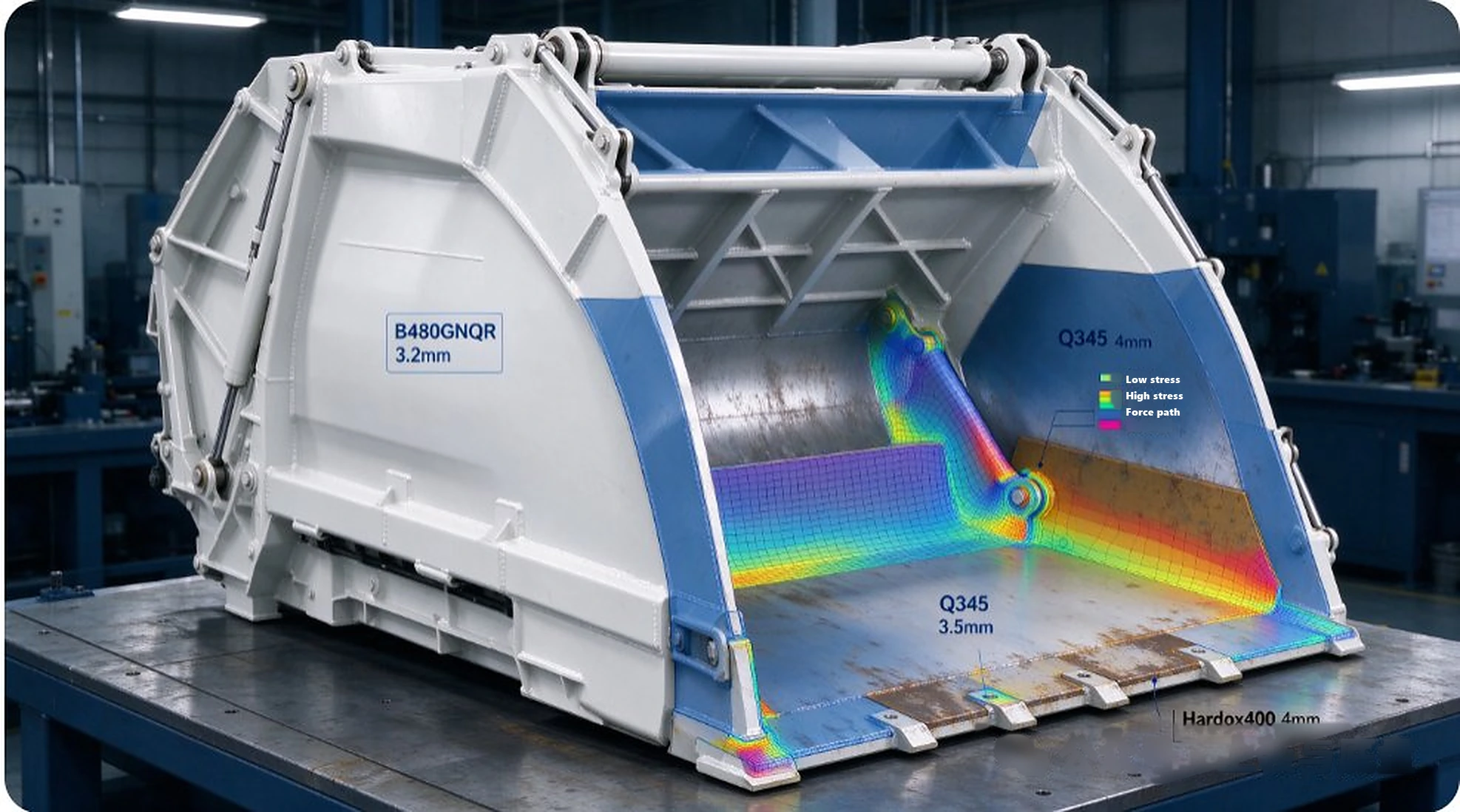
So we stopped specifying one thickness and one steel grade for the whole body. The new design zones the material and varies the plate thickness by calculated stress, wear rate and corrosion exposure. Strength is preserved where it is needed, and mass is removed where it is not.
The mid and rear side plates moved from 4 mm Q345 to 3.2 mm B480GNQR, an atmospheric-corrosion-resistant high-strength steel. The plate is 20% thinner, but yield strength rises from 345 MPa to 480 MPa, so the overall strength margin actually improves by about 11%. B480GNQR also resists corrosion far better: in an industrial atmosphere its corrosion rate is about 43% of Q345's. That matters because a thinner plate has less sacrificial thickness. The steel's corrosion resistance, not an extra millimetre of mild steel, now provides the durability reserve. On 22 m² of side-plate area, the 0.8 mm reduction removes about 140 kg.
The floor is a different problem. It does not see the highest stress, but it sees the worst wear: the pusher plate reciprocates across it hundreds of times a day, with grit, leachate and compacted refuse acting as an abrasive. The traditional answer is to thicken the entire floor plate. The better answer is to leave the structure light and put wear resistance only where the wear happens. The floor base went from 4 mm to 3.5 mm Q345, and a 4 mm Hardox 400 wear liner was added on top. The liner lasts three to four times longer than ordinary steel plate, and it can be replaced locally instead of replacing the whole floor. The base structure loses 25 kg, and maintenance cost falls as well.
The front plate carries the cylinder thrust and the reverse impact of the pusher plate. It is the most severe load case in the body, and it is not a place to save weight. It stays at 4 mm Q345. The discipline of lightweighting is knowing where not to cut.
Material changes alone account for 165 kg — about 55% of the 300 kg target. The remaining 135 kg had to come from the structure and the way it is built.
Many lightweighting programmes fail because they remove material without changing the structure. The body then loses stiffness, deforms under compaction load, and cracks at the welds. The weight number looks good on paper and the truck looks bad in service. We approached the structure as a system, not as a set of panels to be thinned.
The body was modelled in ANSYS Workbench with a mesh of 180,000 elements. Four load cases were run: self-weight, full-load compaction, full-load ejection, and the combined bump-and-emergency-braking case. Each was checked in static analysis, modal analysis and fatigue analysis. The structural optimisation removed about 105 kg while improving the stress distribution rather than merely accepting a lower safety factor.
The old body was a right-angled box, and its weld corners showed pronounced stress peaks. We replaced the flat side with a large-radius curved shell and changed the guide rails to U-shaped, integrally roll-formed truss channels. Compaction load now follows the arc and spreads evenly into the frame instead of concentrating at a corner. For the same refuse volume, the developed area of the curved shell is about 8% smaller than the flat-sided box. The dense transverse ribs that used to stiffen the old body are gone; the truss frame does the same job with far less steel.
The pusher base is the most heavily and most cyclically loaded part of the body. FEA identified the base support as the maximum stress concentration. The original channel-section reinforcement was replaced with a solid steel plate, which raises local stiffness without adding a forest of ribs. A transition fillet was added at the connection, reducing the stress concentration factor from 2.3 to 1.6 and substantially improving structural stability.
The original cylinder hinge seat was a right-angled trapezoidal bracket, and stress piled up in one corner. It was redesigned as an isosceles trapezoidal bent part, so the load is shared by the vertical beams on both sides instead of being concentrated in a single junction. The corner fillet weld was also changed to a butt weld, which is stronger and less sensitive to welding defects. The part is simpler to fabricate and more reliable in fatigue.
Here is the uncomfortable truth about traditional compactor bodies: many of their stiffeners are not there because the structure needs them. They are there because manual welding of high-strength steel is variable. Undercut, porosity and uneven penetration are difficult to eliminate by hand, so engineers add ribs and extra plate thickness to compensate for the uncertainty. The result is structural redundancy that exists to protect against process variation, not to carry load.
The body is now welded on a six-axis robotic MIG line. Heat input is controlled, penetration is stable, and the bead profile is uniform. Weld strength matches the base material closely enough that the join is no longer the weak link in the design. With that consistency in place, the stiffeners can follow the FEA result instead of compensating for the welder: ribs are retained only where calculated stress exceeds 80% of the allowable value, and the rest are removed. Some T-shaped stiffeners were replaced with bent lap joints, which need less welding and distort less. The process change alone removed 30 kg.
This is also the point where lightweighting becomes a manufacturing discipline rather than a drawing exercise. A lighter design is only safe if the factory can reproduce the weld quality that the calculation assumes. The robotic line is what makes the calculation honest at production volume. For a closer look at that line, see our report on China's first robotic welding line for compression garbage bodies.
A lighter body is only an improvement if it passes the same extreme load cases as the heavier one. The validation used the inertia factors common in the industry: 0.5g in the x direction, 1.5g in the y direction and 1.0g in the z direction. Three of the most highly loaded locations were checked individually, and the acceptance criterion was not relaxed by a single percentage point.
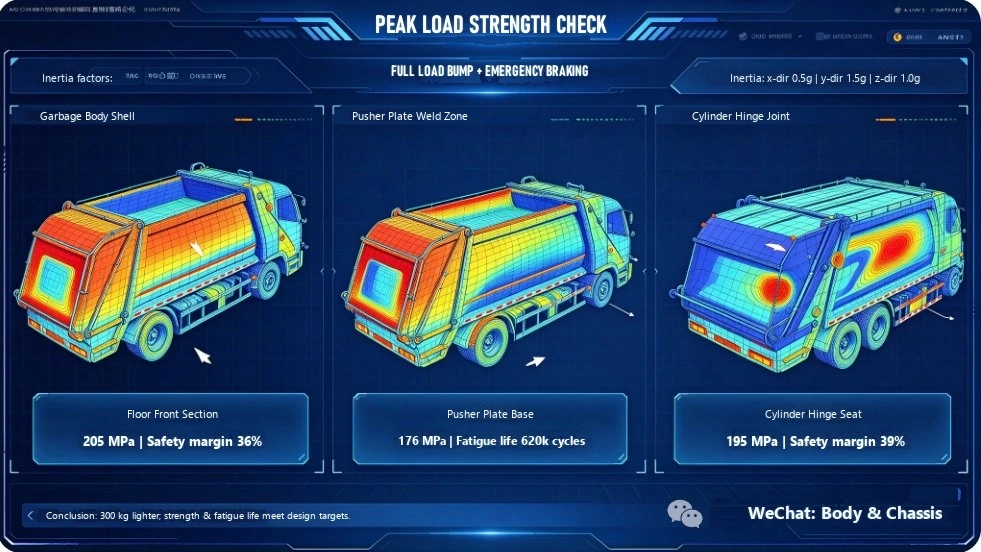
This is the weakest point under emergency braking. After optimisation, the maximum stress is 205 MPa against an allowable stress of 320 MPa — a safety margin of 36%.
This zone carries the alternating compaction load. It was checked against an eight-year service life and 480,000 operating cycles. The calculated fatigue life is 620,000 cycles, which comfortably covers the requirement. Stress at the location fell from 504 MPa before optimisation to 176 MPa after it, while the structure itself became 29.3% lighter.
The worst case here is a jammed pusher plate with the cylinder pushing at 1.5 times its rated load. A local reinforcement plate was added, and stress dropped from 248 MPa to 195 MPa, raising the safety margin to 39%.
| Optimisation area | Weight saved | Key measures |
|---|---|---|
| Material | 165 kg | Side plates 4 mm Q345 to 3.2 mm B480GNQR; local Hardox 400 wear liner on the floor; variable-thickness zoning |
| Structure | 105 kg | Curved shell and truss frame; stress optimisation of the pusher base and cylinder hinge seat |
| Manufacturing | 30 kg | Robotic MIG welding replaces manual welding; redundant stiffeners removed; bent parts replace T-joints |
| Total | 300 kg | Payload rating unchanged; strength and fatigue margins validated |
On the same route, with the same payload and the same driver, the truck now finishes a full collection round without a midday recharge. Measured range is 202 km instead of 160 km. Consumption falls by about 5.5 kWh/100 km, which is worth roughly RMB 2,500 a year at RMB 1.2/kWh. The operational gain is larger than the energy saving: the truck can complete an extra trip in the same shift, and the depot no longer needs to reserve a midday charging slot for it.
The payload rating is unchanged. The body did not become thinner in the places that carry load, and it did not lose its wear protection. What came out was the part of the structure that existed to compensate for uniform material specification and manual weld variation. That is the difference between lightweighting and cutting corners.
On this stop-start municipal duty cycle, every 100 kg removed from the body reduced full-load consumption by about 1.7 to 2.0 kWh/100 km, which translated to roughly 14 km of additional range. The measured 300 kg reduction delivered 42 km, from 160 km to 202 km.
Yes, if the weight is removed by calculation rather than by guesswork. The optimised body retains 36% to 39% safety margins at the three most highly loaded locations, and the pusher base weld zone is rated for 620,000 fatigue cycles against a requirement of 480,000.
B480GNQR raises yield strength from 345 MPa to 480 MPa while allowing the plate to be 20% thinner, so the strength margin improves by about 11%. Its corrosion rate in an industrial atmosphere is about 43% of Q345's, which matters when the plate is thinner and has less sacrificial thickness.
No. Body weight is tare, not payload. In this programme the payload rating was kept unchanged; the gain was lower energy consumption and longer range. Where local regulations allow a higher gross vehicle weight for the same chassis, a lower tare can also release additional legal payload, but that requires a separate re-rating and certification process.
Engineering lightweighting is not a race to remove steel. It is a process of adding precision: simulation, load-case validation, material data and process control. What gets removed is the empirical redundancy, the process compensation and the structural waste that nobody had calculated. The goal is not the most expensive steel, the thickest plate or the most weld metal. The goal is to match every structure and every panel to the stress, wear, life and weight it actually needs.
For a manufacturer, that is product refinement. For a fleet operator, it is a direct gain in working time, operating cost and equipment life. If you are specifying an electric garbage truck for a municipal route, start with the duty cycle and the energy ledger — the body specification should follow from those numbers, not from a catalogue thickness.
Explore our compactor garbage trucks, including the CLW 8×4 electric compactor and the 16 CBM Dongfeng rear-loader. For route planning and model selection, see the garbage truck buying guide, or send us your route profile and we will size the body and battery around it.
Engineering data: CLW body engineering and CAE team. Consumption, range and stress figures are from internal fleet trials and finite element analysis on the 18-tonne electric compactor programme, November 2026.
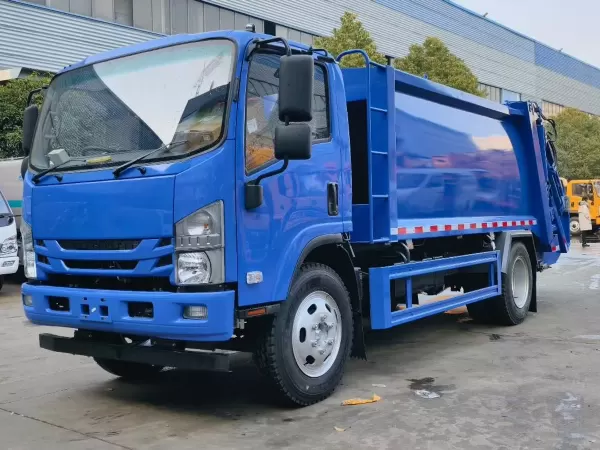 ISUZU ELF 4x2 8m3 Compactor Garbage Truck Light Rear Loader
Garbage Truck
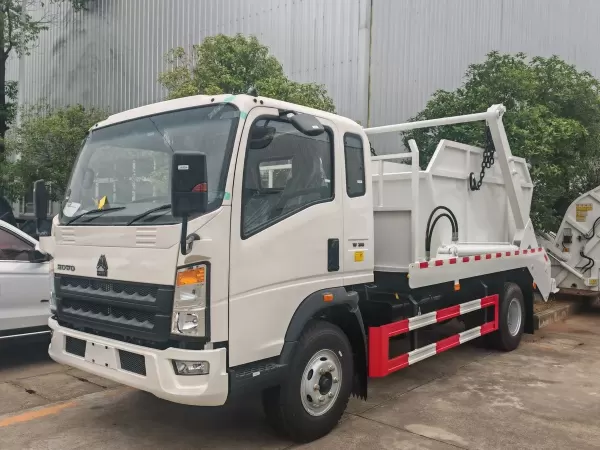 SINOTRUK 4x2 Light Skip Loader Garbage Truck 4m3 Swing-Arm
Garbage Truck
 Dongfeng 10cbm Swing-Arm Bin Lift Garbage Truck
Garbage Truck
 FAW 4x2 Refuse Transfer Truck with Knuckle Boom Crane and Sealed Compression Container
Garbage Truck
Tell us your truck model and quantity — an engineer replies within 12 hours with a factory-direct price.
Tell us the model and your requirement — an engineer replies within 12 hours, factory direct.